SERMON NOTES 03 May 2026
Suffering Series Sermon 3
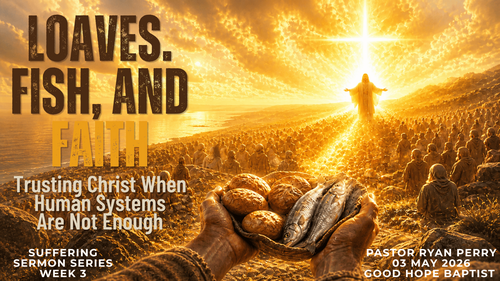
Loaves, Fish, and Faith: Trusting Christ When Human Systems Are Not Enough
God and Suffering — Week 3
Loaves, Fish, and Faith: Trusting Christ When Human Systems Are Not Enough
Pastor Ryan Perry
Good Hope Baptist Church
03 May 2026
Key Verses:
John 6:5–6; Matthew 14:15; John 6:9; John 15:5: Matthew 14:18; Mark 6:37; John 6:9; Matthew 17:20; Philippians 4:19; John 6:10–15; Genesis 50:20; 1 Samuel 17:34–37; Mark 12:41–44; Romans 8:28; John 6:15; John 6:26; John 6:35; Acts 4:32–37; Acts 5:1–11; Mark 10:17–22; Romans 8:18–39; Psalm 23:4; Matthew 6:19–21; Matthew 7:24–27; John 15:5; Hosea 4:6; Proverbs 4:7; Matthew 13:18–23; John 17:3; James 1:22
Big Idea
In a suffering world, faith does not pretend we have enough. Faith brings what is insufficient to Jesus, trusts His lordship, and surrenders our lives to His kingdom purposes.
We ask the question: How do we live faithfully in a suffering world?
I. Suffering Reveals the Limits of Human Systems
John 6:5–6 - ‘Where are we to buy bread, so that these people may eat?’
John 6 puts us in a familiar place. A large crowd, the day is getting late, and people are hungry. The disciples know they do not have enough money, enough bread, or enough ability to meet the need. Andrew points out a boy with five barley loaves and two fish, but even he knows how small that looks beside thousands of people.
Jesus is standing in the middle of the need.
Matthew 14:15 - This is a desolate place, and the day is now over; send the crowds away to go into the villages and buy food for themselves.
Many have stood in that same kind of place, a need that is bigger than our ability, in human capability, an impossible task.
Jesus puts the disciples face-to-face with something they cannot do without Him. Jesus tells them, “You give them something to eat.”
John 6:9 - There is a boy here who has five barley loaves and two fish, but what are they for so many?
What do we do when the need is real, but our ability is not enough?
Do we look at the crowd and say, Go home. We have nothing for you. Or do we take what we see as insufficient and give it to Jesus because it is all we have.
Human strength looks at what we have and says, this will never be enough.
Faith looks at what we have in the hands of Jesus and says, we are not on our own, and with Him, this can become more than enough.
Summary:
The disciples faced a real need that exceeded their resources: a hungry crowd, a desolate place, a late hour, and only five loaves and two fish. Their instinct was to send the need away or solve it through human systems. But Jesus placed them face-to-face with what they could not do without Him.
Human systems ask, “Do we have enough?”
Faith asks, “Is Jesus here?”
II. Jesus Calls Us to Bring Him What Is Not Enough
Matthew 14:18 - Bring them here to me.
Suffering touches both the faithful and the worldly. Blessing touches both the faithful and the worldly. But the worldly spend their lives trying to keep what time, death, and judgment will eventually take from them.
The faithful surrender what they have to Christ and receive what cannot be lost, stolen, corrupted, or taken by death.
John 6 begins with a large crowd following Jesus. They are searching for answers because Jesus has done what no human system could do. Some are sick. Some brought people they love who are sick. Some have already heard the usual answers: try harder, wait longer, pay more, go somewhere else, learn to live with it. But then they see Jesus heal, restore, and show mercy to people who had run out of options. So they follow Him, because in Jesus, they are seeing that suffering may not have the final word.
Matthew tells us Jesus saw the crowd and had compassion on them.
Mark tells us Jesus saw them as sheep without a shepherd.
The disciples look at the crowd and immediately feel insufficient. They do not have enough money, enough bread, or enough ability to handle what Jesus is asking.
But Jesus is not looking at the crowd through their limitation. He has compassion on them. He sees their hunger, but He also sees the sickness, weariness, confusion, and deeper need underneath it all.
Bread matters, and Jesus is going to feed them. But bread is not the final answer. They need the One who gives life. Jesus knows that what they need most is not somewhere in the villages. It is standing right in front of them.
Matthew 14:15 - “This is a desolate place, and the day is now over; send the crowds away to go into the villages and buy food for themselves.”
On the surface, their answer makes sense. The disciples are doing what humans do when the need feels too large. They are measuring the crowd by their own inadequacy. The day is late, the people are hungry, and their resources are small. They reach the only conclusion human strength can reach: We do not have what this situation requires.
The problem is not that they are far from Jesus. It is that the disciples spend every day with Jesus they have knowledge of all that He has done, and yet they still do not understand who He is.
So they start looking for answers in the same places everybody else looks. But apart from Jesus, every answer eventually comes up empty.
Human systems can offer relief for a moment, but they cannot redeem what suffering has broken.
If the disciples understood who was standing beside them, they would know the answer was not somewhere else. Jesus is the ultimate bread supplier, the bottomless bank account, and the conqueror of suffering.
Human systems teach us to think in only two categories: either we are strong enough to handle it ourselves, or it cannot be done. But God teaches us something different. Apart from Me, everything is impossible.
The world says, Be self-sufficient, or give up. Faith says, Be God-dependent, because what He calls us to do cannot be done without Him.
Jesus says, “Abide in Me.”
When we feel insufficient, like the disciples, we are thinking from a worldly perspective, reaching for practical answers that sound wise, but leave Jesus out of the solution.
We can have solutions that may sound reasonable, and may even contain some truth. But it still misses the point if it keeps us from bringing the need to Jesus.
Stewardship, planning, and being responsible are all good, Godly characteristics. But none of those can become a substitute for dependence on what only God can supply.
Human systems teach us self-sufficiency: either we can handle it ourselves, or it cannot be done.
Jesus teaches dependence: apart from Me, you can do nothing, but with Me, there is nothing we cannot accomplish.
Mark 6:37 - “You give them something to eat.”
The disciples' answer exposes their point of view. Shall we go and buy two hundred denarii worth of bread and give it to them to eat?
They immediately translate Jesus' command into human economic terms, counting bread, money, time, and people.
John says Jesus already knew what He was going to do. That matters because everybody else is trying to solve the problem from the ground up. Jesus already knows what He is about to do with what they think is not enough.
Philip answered with correct math, but his theology was too small. He calculated the need without accounting for the presence of Christ.
That is what suffering often exposes in us. When something feels too big for us, we start counting. How much do we have? Who can help? What will this cost? Can we actually do this?
Those are not bad questions. But those questions cannot become lord.
The problem comes when we stop at what we can count and never bring it to Christ.
At that point, faith becomes management, and dependence gets replaced by calculation.
John 6:9 - There is a boy here who has five barley loaves and two fish, but what are they for so many?
Human systems teach us to trust what can be counted, managed, predicted, funded, and controlled. So when what we have looks small, we assume it is useless. But Jesus does not need us to possess enough before we obey. He calls us to bring what we have to Him.
The miracle did not begin with abundance in human hands. It began with surrendering all they had. Five loaves, two fish, and a boy willing to give all he had.
Matthew 17:20 - If you have faith like a grain of mustard seed… nothing will be impossible for you.
This is placing what we have in the hands of Jesus and knowing He can supply all of our needs.
Philippians 4:19 - And my God will supply every need of yours according to his riches in glory in Christ Jesus.
Trust that Christ is Lord over what we cannot multiply. This miracle is not about the food, it is the suffering people behind the need for food. It is about Jesus being the answer to their suffering.
Faith does not say, I have enough strength. Faith says, Lord, I do not have enough, but I give You what I have.
Faith simply refuses to make limitation lord.
Jesus says in Matthew 14:18, Bring them here to me. The disciples wanted to move the need away from Jesus. Jesus moved the need closer to Himself.
Summary:
Jesus did not ask the disciples to possess enough before they obeyed. He asked them to bring what they had. The miracle began not with abundance, but with surrender.
Faith does not say, “I have enough strength.”
Faith says, “Lord, I do not have enough, but I give You what I have.”
III. God Multiplies What Is Surrendered for His Kingdom
Genesis 37-50 - Joseph was faithful in places that looked nothing like promotion. Joseph’s life did not look blessed from the outside. But Joseph did not wait until he had a platform to become faithful. He was faithful in the little, in the hidden, in the painful, and in the unjust.
Joseph consistently gave God all he had.
David was not a perfect man by all his actions but he was a faithful man.
1 Samuel 17:34–37 - David convinces King Saul he can defeat Goliath by recounting how God strengthened him to kill lions and bears to protect his sheep, asserting that the same God will deliver him from the Philistine.
When a giant came before David’s kingdom he was willing to risk everything, even the kingdom trusting God would prevail as he had done in the little things.
Putting what little we have in His hands and being faithful in giving to God.
Human systems ask, Is it enough? Faith asks, Has God asked me to surrender it?
Human systems ask, What will I lose or what will I gain? Faith asks, What can God do with what I place in His hands?
Human systems say, Protect yourself. Faith says, Trust the Lord.
Human systems count scarcity. Faith counts God’s abundant presence.
The loaves and fish are not a principle for getting whatever you want from God. That is not faith. That is using spiritual language to prioritize self-rule, building one’s own kingdom and God being the wishing well.
Summary:
The loaves and fish are not a formula for getting whatever we want from God. They are a picture of surrender. God multiplies obedience, faithfulness, stewardship, and sacrifice when they are placed under the authority of Christ.
God’s multiplication is not for our self-made kingdom.
God multiplies what is surrendered for His kingdom.
IV. Consumer Faith Wants Bread Without Surrender
John 6:15 - the crowd wanted to use Jesus’ power for their version of kingdom. But Jesus refused to let His power be hijacked by human ambition.
God’s multiplication is not for our self-made kingdom. God’s multiplication serves His kingdom.
The issue is what has God placed in my hands that must be surrendered for what He wants?
In suffering, faith does not say, Lord, use Your power to protect my plan. Faith says, Lord, bring my life under Your plan.
Faith does not say, multiply my comfort. Faith says, Make me faithful in Your mission.
Faith does not say, give me enough to avoid dependence. Faith says, teach me to depend on You for what You have called me to do.
This is why Jesus moves from multiplying bread to declaring, “I am the Bread of Life.”
He refuses to let the miracle become a consumer transaction. The miracle was never meant to make people chase bread. The miracle was meant to make people see the power of God in His Son.
After Jesus feeds the five thousand, the people find Him on the other side of the sea. At first glance that sounds like faith. But Jesus exposes their motive.
John 6:26 - the people wanted bread from His hands, but they did not want to surrender under His authority.
They wanted Jesus’ provision or worldly sufficiency, but they did not want a personal relationship with Jesus as Lord of their lives.
The sign was supposed to point them to Christ as the Bread of Life.
That is still one of the dangers in suffering. Pain can drive us to God in faith, but it can also expose that we only want God to maintain the life we already built through striving.
Selfishness wants relief without the relationship, and provision without submission of control of one’s life.
We want God to supply our kingdom at the expense of His and everyone else’s.
In Acts 4, the early church is living in Spirit-filled generosity. Believers are giving freely so there is not a needy person among them. Barnabas sells a field and lays the money at the apostles’ feet.
Then in Acts 5 Ananias and Sapphira sell property and bring money. They appear to be generous. But they keep back part of the proceeds while pretending to give it all.
Peter says in Acts 5:4, You have not lied to man but to God.
The problem was not that they failed to give everything. The sin was deception. The sin of Satan, they wanted the reputation of sacrifice without the reality of surrender. They wanted the appearance of kingdom contribution while secretly preserving control over their own kingdom.
That is the human system hiding inside religious activity. It still gives, but it gives for image. It still follows, but it follows for selfish benefit. It still speaks spiritual language, but it is protecting self-rule underneath.
John 6 and Acts 5 are not identical situations, but they reveal the same kind of danger. The crowd in John 6 wanted to receive from Jesus without truly coming under Jesus’ authority. Ananias and Sapphira wanted to appear surrendered to the Spirit while still managing the outcome for themselves.
Both are forms of false participation. One says, “Feed me, but do not rule me.” The other says, “Honor me, but do not expose me.”
We all come from a place of lack, every one of us. Even if human systems tell us differently.
Mark 10:17–22 - The rich man had much, but he lacked eternal life. He had possessions, morality, status, and religious concern, but Jesus said, “You lack one thing.” He had what the world system could provide, but he was missing what only Christ could give.
The man was broke and alone and didn’t realize it due to deception of the world system.
Summary:
The crowd wanted Jesus’ provision without His rule. Ananias and Sapphira wanted the appearance of surrender without the reality of surrender. Both reveal the danger of trying to use God’s power to preserve our own agenda.
False faith says, “Feed me, but do not rule me.”
Kingdom faith says, “Lord, bring my life under Your authority.”
V. Faithful Suffering Produces What Human Systems Cannot
Suffering happens on both sides, the worldly system and God’s faithful. The faithful suffer, and the worldly suffer.
The difference is what suffering produces in the hands of God.
Worldly suffering often produces fear, bitterness, control, self-protection, blame, appetite, deception, anxiety, worry, and hardness of heart.
Faithful suffering becomes a place where God supplies what the human system cannot produce.
God supplies presence, endurance, wisdom, provision, understanding, purpose, fruit, and hope.
Faith does not mean I never walk through the valley. Faith means the Shepherd is with me there.
Psalm 23:4 – does not say, “You will never walk through the valley of the shadow of death.” It says, “I will fear no evil, for you are with me.
That is the blessing through suffering. Not escape, but the presence of Jesus in relationship forever.
Summary:
Faith does not remove all suffering. The faithful and the worldly both suffer. The difference is what suffering produces in the hands of God. Worldly suffering produces fear, control, bitterness, and self-protection. Faithful suffering becomes a place where God supplies presence, endurance, wisdom, provision, purpose, fruit, and hope.
Faith does not mean we never walk through the valley.
Faith means the Shepherd is with us there.
VI. True Understanding Becomes Obedient Faith
Hosea 4:6 - “My people are destroyed for lack of knowledge.”
But knowledge there does not mean they had no religious information. The problem was not ignorance.
They had seen Jesus heal, restore, and do what no human system could do. The problem was that what they knew about Jesus had not course corrected their ambition for kingdom.
That is the difference between information and understanding. Understanding is knowledge that has taken root in a person's life.
Proverbs 4:7 - “The beginning of wisdom is this: Get wisdom, and whatever you get, get insight.”
Insight means understanding. It is the ability to see what something means, where it leads, and how to live in light of it.
John 17:3 - “This is eternal life, that they know you, the only true God, and Jesus Christ whom you have sent.”
Knowing God means more than knowing facts about God. It means we trust Him, follow Him, and let His truth shape how we live. That is the kind of knowledge that leads to life. That is worship.
James 1:22 - But be doers of the word, and not hearers only, deceiving yourselves.
Summary:
The crowd had knowledge of Jesus’ power, but they did not understand the sign. The bread was meant to point them to Christ, the Bread of Life. Biblical knowledge is not merely information; it is truth received, understood, trusted, and obeyed.
Understanding is knowledge in action.
To know the truth and not live it is to reject it.
VII. Vision 2030 Application: Put the Loaves and Fish in Jesus’ Hands
For Vision 2030, as a church, we have to put our loaves and fish in the hands of Jesus.
Our responsibility is not to make it happen in our own strength. Our responsibility is to surrender what He has already placed in our hands and watch in expectation what He does with it for His kingdom.
We put our people, our gifts, our resources, our land, our buildings, our prayers, our families, our time, our testimony, our suffering, our blessing, and our future in the hands of Jesus. We surrender it all to Him.
The human system says: keep what you have because it is not enough.
Faith says: give what you have to Jesus because He is more than enough.
Vision 2030 is not us saying: look what we can do. It is us saying, Lord, this is the vision You gave us. Here are the loaves and fish. Take what we have, multiply what we cannot, and use this church to feed people with the hope of Christ in Spotsylvania, in Virginia, in the U.S.A, and in the world.
We have seen God work. God has carried us through deafness, disease, sickness, pain, injuries, mental anguish, poverty, hunger, conflict, power struggles, money issues, and more than we can name.
He has preserved us because He wants to use us as His image bearers, His royal priesthood, His sons and daughters, in relationship with Him, to build His kingdom right here in Virginia for the glory of God.
Bring Him the little you have, and trust Him with what only He can do.
Summary:
As a church, Vision 2030 is not about proving what we can do. It is about surrendering what God has placed in our hands: our people, gifts, land, buildings, prayers, families, testimony, suffering, blessing, and future.
The human system says, “Keep what you have because it is not enough.”
Faith says, “Give what you have to Jesus because He is more than enough.”
Closing
Suffering is real, but it is not sovereign. Human systems are limited, but Christ is not. Faith brings the need, the lack, the grief, the resources, and the future to Jesus—and trusts Him to multiply what we cannot.
Loaves, Fish, and Faith: Trusting Christ When Human Systems Are Not Enough
Pastor Ryan Perry
Good Hope Baptist Church
03 May 2026
Key Verses:
John 6:5–6; Matthew 14:15; John 6:9; John 15:5: Matthew 14:18; Mark 6:37; John 6:9; Matthew 17:20; Philippians 4:19; John 6:10–15; Genesis 50:20; 1 Samuel 17:34–37; Mark 12:41–44; Romans 8:28; John 6:15; John 6:26; John 6:35; Acts 4:32–37; Acts 5:1–11; Mark 10:17–22; Romans 8:18–39; Psalm 23:4; Matthew 6:19–21; Matthew 7:24–27; John 15:5; Hosea 4:6; Proverbs 4:7; Matthew 13:18–23; John 17:3; James 1:22
Big Idea
In a suffering world, faith does not pretend we have enough. Faith brings what is insufficient to Jesus, trusts His lordship, and surrenders our lives to His kingdom purposes.
We ask the question: How do we live faithfully in a suffering world?
I. Suffering Reveals the Limits of Human Systems
John 6:5–6 - ‘Where are we to buy bread, so that these people may eat?’
John 6 puts us in a familiar place. A large crowd, the day is getting late, and people are hungry. The disciples know they do not have enough money, enough bread, or enough ability to meet the need. Andrew points out a boy with five barley loaves and two fish, but even he knows how small that looks beside thousands of people.
Jesus is standing in the middle of the need.
Matthew 14:15 - This is a desolate place, and the day is now over; send the crowds away to go into the villages and buy food for themselves.
Many have stood in that same kind of place, a need that is bigger than our ability, in human capability, an impossible task.
Jesus puts the disciples face-to-face with something they cannot do without Him. Jesus tells them, “You give them something to eat.”
John 6:9 - There is a boy here who has five barley loaves and two fish, but what are they for so many?
What do we do when the need is real, but our ability is not enough?
Do we look at the crowd and say, Go home. We have nothing for you. Or do we take what we see as insufficient and give it to Jesus because it is all we have.
Human strength looks at what we have and says, this will never be enough.
Faith looks at what we have in the hands of Jesus and says, we are not on our own, and with Him, this can become more than enough.
Summary:
The disciples faced a real need that exceeded their resources: a hungry crowd, a desolate place, a late hour, and only five loaves and two fish. Their instinct was to send the need away or solve it through human systems. But Jesus placed them face-to-face with what they could not do without Him.
Human systems ask, “Do we have enough?”
Faith asks, “Is Jesus here?”
II. Jesus Calls Us to Bring Him What Is Not Enough
Matthew 14:18 - Bring them here to me.
Suffering touches both the faithful and the worldly. Blessing touches both the faithful and the worldly. But the worldly spend their lives trying to keep what time, death, and judgment will eventually take from them.
The faithful surrender what they have to Christ and receive what cannot be lost, stolen, corrupted, or taken by death.
John 6 begins with a large crowd following Jesus. They are searching for answers because Jesus has done what no human system could do. Some are sick. Some brought people they love who are sick. Some have already heard the usual answers: try harder, wait longer, pay more, go somewhere else, learn to live with it. But then they see Jesus heal, restore, and show mercy to people who had run out of options. So they follow Him, because in Jesus, they are seeing that suffering may not have the final word.
Matthew tells us Jesus saw the crowd and had compassion on them.
Mark tells us Jesus saw them as sheep without a shepherd.
The disciples look at the crowd and immediately feel insufficient. They do not have enough money, enough bread, or enough ability to handle what Jesus is asking.
But Jesus is not looking at the crowd through their limitation. He has compassion on them. He sees their hunger, but He also sees the sickness, weariness, confusion, and deeper need underneath it all.
Bread matters, and Jesus is going to feed them. But bread is not the final answer. They need the One who gives life. Jesus knows that what they need most is not somewhere in the villages. It is standing right in front of them.
Matthew 14:15 - “This is a desolate place, and the day is now over; send the crowds away to go into the villages and buy food for themselves.”
On the surface, their answer makes sense. The disciples are doing what humans do when the need feels too large. They are measuring the crowd by their own inadequacy. The day is late, the people are hungry, and their resources are small. They reach the only conclusion human strength can reach: We do not have what this situation requires.
The problem is not that they are far from Jesus. It is that the disciples spend every day with Jesus they have knowledge of all that He has done, and yet they still do not understand who He is.
So they start looking for answers in the same places everybody else looks. But apart from Jesus, every answer eventually comes up empty.
Human systems can offer relief for a moment, but they cannot redeem what suffering has broken.
If the disciples understood who was standing beside them, they would know the answer was not somewhere else. Jesus is the ultimate bread supplier, the bottomless bank account, and the conqueror of suffering.
Human systems teach us to think in only two categories: either we are strong enough to handle it ourselves, or it cannot be done. But God teaches us something different. Apart from Me, everything is impossible.
The world says, Be self-sufficient, or give up. Faith says, Be God-dependent, because what He calls us to do cannot be done without Him.
Jesus says, “Abide in Me.”
When we feel insufficient, like the disciples, we are thinking from a worldly perspective, reaching for practical answers that sound wise, but leave Jesus out of the solution.
We can have solutions that may sound reasonable, and may even contain some truth. But it still misses the point if it keeps us from bringing the need to Jesus.
Stewardship, planning, and being responsible are all good, Godly characteristics. But none of those can become a substitute for dependence on what only God can supply.
Human systems teach us self-sufficiency: either we can handle it ourselves, or it cannot be done.
Jesus teaches dependence: apart from Me, you can do nothing, but with Me, there is nothing we cannot accomplish.
Mark 6:37 - “You give them something to eat.”
The disciples' answer exposes their point of view. Shall we go and buy two hundred denarii worth of bread and give it to them to eat?
They immediately translate Jesus' command into human economic terms, counting bread, money, time, and people.
John says Jesus already knew what He was going to do. That matters because everybody else is trying to solve the problem from the ground up. Jesus already knows what He is about to do with what they think is not enough.
Philip answered with correct math, but his theology was too small. He calculated the need without accounting for the presence of Christ.
That is what suffering often exposes in us. When something feels too big for us, we start counting. How much do we have? Who can help? What will this cost? Can we actually do this?
Those are not bad questions. But those questions cannot become lord.
The problem comes when we stop at what we can count and never bring it to Christ.
At that point, faith becomes management, and dependence gets replaced by calculation.
John 6:9 - There is a boy here who has five barley loaves and two fish, but what are they for so many?
Human systems teach us to trust what can be counted, managed, predicted, funded, and controlled. So when what we have looks small, we assume it is useless. But Jesus does not need us to possess enough before we obey. He calls us to bring what we have to Him.
The miracle did not begin with abundance in human hands. It began with surrendering all they had. Five loaves, two fish, and a boy willing to give all he had.
Matthew 17:20 - If you have faith like a grain of mustard seed… nothing will be impossible for you.
This is placing what we have in the hands of Jesus and knowing He can supply all of our needs.
Philippians 4:19 - And my God will supply every need of yours according to his riches in glory in Christ Jesus.
Trust that Christ is Lord over what we cannot multiply. This miracle is not about the food, it is the suffering people behind the need for food. It is about Jesus being the answer to their suffering.
Faith does not say, I have enough strength. Faith says, Lord, I do not have enough, but I give You what I have.
Faith simply refuses to make limitation lord.
Jesus says in Matthew 14:18, Bring them here to me. The disciples wanted to move the need away from Jesus. Jesus moved the need closer to Himself.
Summary:
Jesus did not ask the disciples to possess enough before they obeyed. He asked them to bring what they had. The miracle began not with abundance, but with surrender.
Faith does not say, “I have enough strength.”
Faith says, “Lord, I do not have enough, but I give You what I have.”
III. God Multiplies What Is Surrendered for His Kingdom
Genesis 37-50 - Joseph was faithful in places that looked nothing like promotion. Joseph’s life did not look blessed from the outside. But Joseph did not wait until he had a platform to become faithful. He was faithful in the little, in the hidden, in the painful, and in the unjust.
Joseph consistently gave God all he had.
David was not a perfect man by all his actions but he was a faithful man.
1 Samuel 17:34–37 - David convinces King Saul he can defeat Goliath by recounting how God strengthened him to kill lions and bears to protect his sheep, asserting that the same God will deliver him from the Philistine.
When a giant came before David’s kingdom he was willing to risk everything, even the kingdom trusting God would prevail as he had done in the little things.
Putting what little we have in His hands and being faithful in giving to God.
Human systems ask, Is it enough? Faith asks, Has God asked me to surrender it?
Human systems ask, What will I lose or what will I gain? Faith asks, What can God do with what I place in His hands?
Human systems say, Protect yourself. Faith says, Trust the Lord.
Human systems count scarcity. Faith counts God’s abundant presence.
The loaves and fish are not a principle for getting whatever you want from God. That is not faith. That is using spiritual language to prioritize self-rule, building one’s own kingdom and God being the wishing well.
Summary:
The loaves and fish are not a formula for getting whatever we want from God. They are a picture of surrender. God multiplies obedience, faithfulness, stewardship, and sacrifice when they are placed under the authority of Christ.
God’s multiplication is not for our self-made kingdom.
God multiplies what is surrendered for His kingdom.
IV. Consumer Faith Wants Bread Without Surrender
John 6:15 - the crowd wanted to use Jesus’ power for their version of kingdom. But Jesus refused to let His power be hijacked by human ambition.
God’s multiplication is not for our self-made kingdom. God’s multiplication serves His kingdom.
The issue is what has God placed in my hands that must be surrendered for what He wants?
In suffering, faith does not say, Lord, use Your power to protect my plan. Faith says, Lord, bring my life under Your plan.
Faith does not say, multiply my comfort. Faith says, Make me faithful in Your mission.
Faith does not say, give me enough to avoid dependence. Faith says, teach me to depend on You for what You have called me to do.
This is why Jesus moves from multiplying bread to declaring, “I am the Bread of Life.”
He refuses to let the miracle become a consumer transaction. The miracle was never meant to make people chase bread. The miracle was meant to make people see the power of God in His Son.
After Jesus feeds the five thousand, the people find Him on the other side of the sea. At first glance that sounds like faith. But Jesus exposes their motive.
John 6:26 - the people wanted bread from His hands, but they did not want to surrender under His authority.
They wanted Jesus’ provision or worldly sufficiency, but they did not want a personal relationship with Jesus as Lord of their lives.
The sign was supposed to point them to Christ as the Bread of Life.
That is still one of the dangers in suffering. Pain can drive us to God in faith, but it can also expose that we only want God to maintain the life we already built through striving.
Selfishness wants relief without the relationship, and provision without submission of control of one’s life.
We want God to supply our kingdom at the expense of His and everyone else’s.
In Acts 4, the early church is living in Spirit-filled generosity. Believers are giving freely so there is not a needy person among them. Barnabas sells a field and lays the money at the apostles’ feet.
Then in Acts 5 Ananias and Sapphira sell property and bring money. They appear to be generous. But they keep back part of the proceeds while pretending to give it all.
Peter says in Acts 5:4, You have not lied to man but to God.
The problem was not that they failed to give everything. The sin was deception. The sin of Satan, they wanted the reputation of sacrifice without the reality of surrender. They wanted the appearance of kingdom contribution while secretly preserving control over their own kingdom.
That is the human system hiding inside religious activity. It still gives, but it gives for image. It still follows, but it follows for selfish benefit. It still speaks spiritual language, but it is protecting self-rule underneath.
John 6 and Acts 5 are not identical situations, but they reveal the same kind of danger. The crowd in John 6 wanted to receive from Jesus without truly coming under Jesus’ authority. Ananias and Sapphira wanted to appear surrendered to the Spirit while still managing the outcome for themselves.
Both are forms of false participation. One says, “Feed me, but do not rule me.” The other says, “Honor me, but do not expose me.”
We all come from a place of lack, every one of us. Even if human systems tell us differently.
Mark 10:17–22 - The rich man had much, but he lacked eternal life. He had possessions, morality, status, and religious concern, but Jesus said, “You lack one thing.” He had what the world system could provide, but he was missing what only Christ could give.
The man was broke and alone and didn’t realize it due to deception of the world system.
Summary:
The crowd wanted Jesus’ provision without His rule. Ananias and Sapphira wanted the appearance of surrender without the reality of surrender. Both reveal the danger of trying to use God’s power to preserve our own agenda.
False faith says, “Feed me, but do not rule me.”
Kingdom faith says, “Lord, bring my life under Your authority.”
V. Faithful Suffering Produces What Human Systems Cannot
Suffering happens on both sides, the worldly system and God’s faithful. The faithful suffer, and the worldly suffer.
The difference is what suffering produces in the hands of God.
Worldly suffering often produces fear, bitterness, control, self-protection, blame, appetite, deception, anxiety, worry, and hardness of heart.
Faithful suffering becomes a place where God supplies what the human system cannot produce.
God supplies presence, endurance, wisdom, provision, understanding, purpose, fruit, and hope.
Faith does not mean I never walk through the valley. Faith means the Shepherd is with me there.
Psalm 23:4 – does not say, “You will never walk through the valley of the shadow of death.” It says, “I will fear no evil, for you are with me.
That is the blessing through suffering. Not escape, but the presence of Jesus in relationship forever.
Summary:
Faith does not remove all suffering. The faithful and the worldly both suffer. The difference is what suffering produces in the hands of God. Worldly suffering produces fear, control, bitterness, and self-protection. Faithful suffering becomes a place where God supplies presence, endurance, wisdom, provision, purpose, fruit, and hope.
Faith does not mean we never walk through the valley.
Faith means the Shepherd is with us there.
VI. True Understanding Becomes Obedient Faith
Hosea 4:6 - “My people are destroyed for lack of knowledge.”
But knowledge there does not mean they had no religious information. The problem was not ignorance.
They had seen Jesus heal, restore, and do what no human system could do. The problem was that what they knew about Jesus had not course corrected their ambition for kingdom.
That is the difference between information and understanding. Understanding is knowledge that has taken root in a person's life.
Proverbs 4:7 - “The beginning of wisdom is this: Get wisdom, and whatever you get, get insight.”
Insight means understanding. It is the ability to see what something means, where it leads, and how to live in light of it.
John 17:3 - “This is eternal life, that they know you, the only true God, and Jesus Christ whom you have sent.”
Knowing God means more than knowing facts about God. It means we trust Him, follow Him, and let His truth shape how we live. That is the kind of knowledge that leads to life. That is worship.
James 1:22 - But be doers of the word, and not hearers only, deceiving yourselves.
Summary:
The crowd had knowledge of Jesus’ power, but they did not understand the sign. The bread was meant to point them to Christ, the Bread of Life. Biblical knowledge is not merely information; it is truth received, understood, trusted, and obeyed.
Understanding is knowledge in action.
To know the truth and not live it is to reject it.
VII. Vision 2030 Application: Put the Loaves and Fish in Jesus’ Hands
For Vision 2030, as a church, we have to put our loaves and fish in the hands of Jesus.
Our responsibility is not to make it happen in our own strength. Our responsibility is to surrender what He has already placed in our hands and watch in expectation what He does with it for His kingdom.
We put our people, our gifts, our resources, our land, our buildings, our prayers, our families, our time, our testimony, our suffering, our blessing, and our future in the hands of Jesus. We surrender it all to Him.
The human system says: keep what you have because it is not enough.
Faith says: give what you have to Jesus because He is more than enough.
Vision 2030 is not us saying: look what we can do. It is us saying, Lord, this is the vision You gave us. Here are the loaves and fish. Take what we have, multiply what we cannot, and use this church to feed people with the hope of Christ in Spotsylvania, in Virginia, in the U.S.A, and in the world.
We have seen God work. God has carried us through deafness, disease, sickness, pain, injuries, mental anguish, poverty, hunger, conflict, power struggles, money issues, and more than we can name.
He has preserved us because He wants to use us as His image bearers, His royal priesthood, His sons and daughters, in relationship with Him, to build His kingdom right here in Virginia for the glory of God.
Bring Him the little you have, and trust Him with what only He can do.
Summary:
As a church, Vision 2030 is not about proving what we can do. It is about surrendering what God has placed in our hands: our people, gifts, land, buildings, prayers, families, testimony, suffering, blessing, and future.
The human system says, “Keep what you have because it is not enough.”
Faith says, “Give what you have to Jesus because He is more than enough.”
Closing
Suffering is real, but it is not sovereign. Human systems are limited, but Christ is not. Faith brings the need, the lack, the grief, the resources, and the future to Jesus—and trusts Him to multiply what we cannot.
Posted in Sermon Notes
Recent
Archive
2026
January
February
March
Sermon Study Guide 01 March 2026Parent Discipleship Guide 01 March 2026Sermon Notes 08 March 2026Devotional Guide 08 March 2026Parent Discipleship Guide 08 March 2026Bulletin 08 March 2026Bulletin 15 March 2026Sermon Notes 15 March 2026Parent Discipleship Guide 15 March 2026Devotional Guide 15 March 2026Sermon Notes 22 March 2026Devotional Guide 22 March 2026Parent Discipleship Guide 22 March 2026Bulletin 22 March 2026Sermon Notes 29 March 2026Devotional Guide 29 March 2026Parent Discipleship Guide 29 March 2026Bulletin 29 March 2026
April
Sermon Notes 05 April 2026Devotional Guide 05 April 2026Parent Discipleship Guide 05 April 2026Bulletin 05 April 2026Sermon Notes 12 April 2026Bulletin 12 April 2026Sermon Notes 19 April 2026Parent Discipleship Guide 19 April 2026 Devotional Guide 19 April 2026Bulletin 19 April 2026Bulletin 26 April 2026Sermon Notes 26 April 2026Devotional Guide 26 April 2026Parent Discipleship Guide 26 April 2026
May
June
2025
July
August
September