SERMON NOTES 08 MARCH 2026
Passover 2026 Sermon 2:
Pesach - The God Who Stands Between
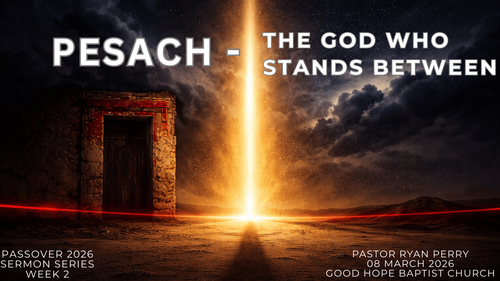
Passover 2026 Sermon 2
Pesach – The God Who Stands Between
Pastor Ryan Perry
Good Hope Baptist Church
8 March 2026
In this series we are walking toward Easter by entering the story of Passover – the story God gave long before Jesus was born -- to teach His people how He saves.
Primary Texts:
Thesis: Passover is not about God skipping His people. It is about God covering His people.
If we misunderstand Passover, we will misunderstand the Last Supper, and we will misunderstand the cross.
I. What “Passover” Means
Jesus Last Supper with His disciples was during Passover, using a story they already knew to reveal what He was about to do.
But before we talk about a table, before we talk about bread and wine, before we talk about the cross and resurrection, we need to understand what Passover actually means.
Because, if we misunderstand Passover, we will misunderstand the Last Supper, and we will misunderstand the cross.
The Hebrew word translated Passover is Pesakh (פֶּסַח). It comes from a verb, Pasakh (פסח).
Most of us grew up hearing that Passover means “God skipped over the houses.” That’s not wrong, but it’s incomplete.
Isaiah 31:5 – Isaiah uses this same verb, “…and passing over (פסח) He will preserve it.” Here, pasakh does not mean “bypass.” It means to hover, to shield, to stand protectively over.
God pays the price while the people inside are protected from the judgment.
Passover is not about absence. It is about presence.
Matthew 23:37 – A hen covers her chicks with her own body. That is the picture of Pesakh.
God has always saved His people the same way.
II. The Ark as a Picture of Covering
Genesis 7:16 – God did not tell Noah, “Good luck.” God closed the door Himself. Judgment fell outside the ark. Protection existed inside the ark.
Passover works the same way.
But there is even more Passover language here than we usually notice.
Genesis 6:14 – The Hebrew word translated “pitch” is כֹּפֶר (kōpher). It comes from the same root as כִּפֻּר (kippur) — atonement. כָּפַר (kaphar) — to cover, to ransom, to make reconciliation.
The ark was sealed all the way around. It was airtight; nothing from the outside could get in. It became a visible picture of what God was doing: placing a complete covering around Noah’s family so that the destruction outside could not reach them.
Before Noah ever entered the ark, God commanded that it be covered.
What the Ark Was Teaching: The ark was not saved because it floated well. The ark was saved because it was covered.
The flood did not disappear. Judgment still came.
But judgment could not penetrate what God had covered.
That is Passover logic before Passover existed.
The ark was covered with kōpher, The door was shut by the LORD. The blood later covered the doorposts in Egypt. Christ’s blood covers sinners at the cross.
Same God -- Same method -- Same mercy.
III. God Moves Toward His People
God does not remove judgment; He provides a covering that judgment cannot penetrate.
When God later tells Israel, “When I see the blood, I will pass over you,” He is not inventing something new. He is repeating what He has always done – He covers His people and stands between them and destruction.
Genesis doesn’t use the word Passover, but it uses the same theology. The ark was covered. The doorposts were covered. The cross covers us still.
Exodus 3:7–8 - Notice the language: God saw, God heard, and God came down. Passover begins with a God who moves toward suffering people.
IV. The Passover Instructions
Exodus 12:3–6; Exodus 12:7 – God gives specific instructions in the first Passover.
Exodus 12:13 – This is the heart of Passover. God does not say, “When I see your sincerity.” “When I see your obedience.” “When I see your suffering.” He says, “When I see the blood.”
The blood did not scare God away. The blood marked where God would stand.
Passover is God positioning Himself between His people and death.
Judgment still comes. Death still passes through Egypt. But where the blood is present, God stands guard.
Every firstborn in Egypt died rich, poor, powerful, and powerless. The difference was not behavior. The difference was trusting God’s provision.
Protection was not automatic. It had to be received.
V. Conclusion – Passover Becomes Personal
Many people believe God saves from a distance: by advice, by instruction, and by improvement.
Passover says that God saves by standing in the way.
Passover is not about God skipping His people. It is about God covering His people.
At Passover in Egypt, blood was placed on wood -- At Calvary, blood was placed on wood.
In Egypt, God stood between Israel and death -- At the cross, God stands between humanity and judgment.
Some of us are still trying to face danger alone. Passover invites us to stop striving and step under God’s covering.
You don’t need better behavior. You need the blood God has provided.
The question has never been whether danger exists. The question is whether you are under God’s protection.
Next week, we’ll ask the next question, "Why did a lamb have to die at all?"
Pesach – The God Who Stands Between
Pastor Ryan Perry
Good Hope Baptist Church
8 March 2026
In this series we are walking toward Easter by entering the story of Passover – the story God gave long before Jesus was born -- to teach His people how He saves.
Primary Texts:
- Genesis 7:15–16
“And the LORD shut him in.” - Exodus 12:1–13
The instructions for the first Passover and the promise:
“When I see the blood, I will pass over you.” - Isaiah 31:5
“As birds flying, so will the LORD of hosts defend Jerusalem… passing over He will preserve it.” - Matthew 23:37
“How often would I have gathered your children together as a hen gathers her brood under her wings…”
Thesis: Passover is not about God skipping His people. It is about God covering His people.
If we misunderstand Passover, we will misunderstand the Last Supper, and we will misunderstand the cross.
I. What “Passover” Means
Jesus Last Supper with His disciples was during Passover, using a story they already knew to reveal what He was about to do.
But before we talk about a table, before we talk about bread and wine, before we talk about the cross and resurrection, we need to understand what Passover actually means.
Because, if we misunderstand Passover, we will misunderstand the Last Supper, and we will misunderstand the cross.
The Hebrew word translated Passover is Pesakh (פֶּסַח). It comes from a verb, Pasakh (פסח).
Most of us grew up hearing that Passover means “God skipped over the houses.” That’s not wrong, but it’s incomplete.
Isaiah 31:5 – Isaiah uses this same verb, “…and passing over (פסח) He will preserve it.” Here, pasakh does not mean “bypass.” It means to hover, to shield, to stand protectively over.
God pays the price while the people inside are protected from the judgment.
Passover is not about absence. It is about presence.
Matthew 23:37 – A hen covers her chicks with her own body. That is the picture of Pesakh.
God has always saved His people the same way.
II. The Ark as a Picture of Covering
Genesis 7:16 – God did not tell Noah, “Good luck.” God closed the door Himself. Judgment fell outside the ark. Protection existed inside the ark.
Passover works the same way.
But there is even more Passover language here than we usually notice.
Genesis 6:14 – The Hebrew word translated “pitch” is כֹּפֶר (kōpher). It comes from the same root as כִּפֻּר (kippur) — atonement. כָּפַר (kaphar) — to cover, to ransom, to make reconciliation.
The ark was sealed all the way around. It was airtight; nothing from the outside could get in. It became a visible picture of what God was doing: placing a complete covering around Noah’s family so that the destruction outside could not reach them.
Before Noah ever entered the ark, God commanded that it be covered.
What the Ark Was Teaching: The ark was not saved because it floated well. The ark was saved because it was covered.
The flood did not disappear. Judgment still came.
But judgment could not penetrate what God had covered.
That is Passover logic before Passover existed.
The ark was covered with kōpher, The door was shut by the LORD. The blood later covered the doorposts in Egypt. Christ’s blood covers sinners at the cross.
Same God -- Same method -- Same mercy.
III. God Moves Toward His People
God does not remove judgment; He provides a covering that judgment cannot penetrate.
When God later tells Israel, “When I see the blood, I will pass over you,” He is not inventing something new. He is repeating what He has always done – He covers His people and stands between them and destruction.
Genesis doesn’t use the word Passover, but it uses the same theology. The ark was covered. The doorposts were covered. The cross covers us still.
Exodus 3:7–8 - Notice the language: God saw, God heard, and God came down. Passover begins with a God who moves toward suffering people.
IV. The Passover Instructions
Exodus 12:3–6; Exodus 12:7 – God gives specific instructions in the first Passover.
Exodus 12:13 – This is the heart of Passover. God does not say, “When I see your sincerity.” “When I see your obedience.” “When I see your suffering.” He says, “When I see the blood.”
The blood did not scare God away. The blood marked where God would stand.
Passover is God positioning Himself between His people and death.
Judgment still comes. Death still passes through Egypt. But where the blood is present, God stands guard.
Every firstborn in Egypt died rich, poor, powerful, and powerless. The difference was not behavior. The difference was trusting God’s provision.
Protection was not automatic. It had to be received.
V. Conclusion – Passover Becomes Personal
Many people believe God saves from a distance: by advice, by instruction, and by improvement.
Passover says that God saves by standing in the way.
Passover is not about God skipping His people. It is about God covering His people.
At Passover in Egypt, blood was placed on wood -- At Calvary, blood was placed on wood.
In Egypt, God stood between Israel and death -- At the cross, God stands between humanity and judgment.
Some of us are still trying to face danger alone. Passover invites us to stop striving and step under God’s covering.
You don’t need better behavior. You need the blood God has provided.
The question has never been whether danger exists. The question is whether you are under God’s protection.
Next week, we’ll ask the next question, "Why did a lamb have to die at all?"
Posted in Sermon Notes
Recent
Archive
2026
January
February
March
Sermon Study Guide 01 March 2026Parent Discipleship Guide 01 March 2026Sermon Notes 08 March 2026Devotional Guide 08 March 2026Parent Discipleship Guide 08 March 2026Bulletin 08 March 2026Bulletin 15 March 2026Sermon Notes 15 March 2026Parent Discipleship Guide 15 March 2026Devotional Guide 15 March 2026Sermon Notes 22 March 2026Devotional Guide 22 March 2026Parent Discipleship Guide 22 March 2026Bulletin 22 March 2026Sermon Notes 29 March 2026Devotional Guide 29 March 2026Parent Discipleship Guide 29 March 2026Bulletin 29 March 2026
April
Sermon Notes 05 April 2026Devotional Guide 05 April 2026Parent Discipleship Guide 05 April 2026Bulletin 05 April 2026Sermon Notes 12 April 2026Bulletin 12 April 2026Sermon Notes 19 April 2026Parent Discipleship Guide 19 April 2026 Devotional Guide 19 April 2026Bulletin 19 April 2026Bulletin 26 April 2026Sermon Notes 26 April 2026Devotional Guide 26 April 2026Parent Discipleship Guide 26 April 2026
May
June
2025
July
August
September