SERMON NOTES 22 MARCH 2026
Passover 2026 Sermon 4:
Pesach - The Table, The Cup, and the Cost of Covering
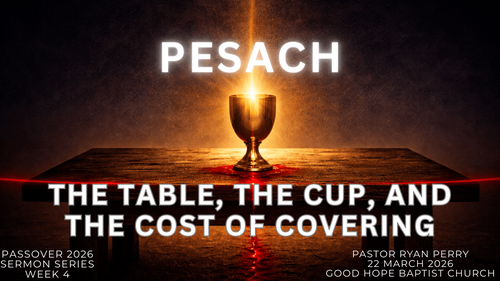
PASSOVER 2026 Sermon 4: Pesakh – The Table, The Cup, and the Cost of Covering
Pastor Ryan Perry
Good Hope Baptist Church
22 March 2026
Primary Texts
In this series we are walking toward Easter by entering the story of Passover – the story God gave long before Jesus was born, to teach His people how He saves.
Last week we asked. “Why did a lamb have to die?” We saw that God does not ignore sin. Because God set creation apart for life and covenant, sin cannot go unanswered. And instead of demanding that cost from us, God chose to absorb it Himself.
Today we come to the table what Christians often call the Last Supper. But before we read a single verse, we must understand something crucial. This was not a spontaneous meal. This was not a new ritual.
Thesis:
From the very beginning, God’s plan was to restore the life that was lost when sin first entered the world.
The Passover meal that began in the upper room is completed on the cross. The Lamb is sacrificed. The redemption cup is fulfilled. The final cup is finished.
The table leads to the cross. And the cross finishes the meal.
I. The Passover as Teaching & Memorial
Luke 22:15 – This was the Passover Seder – a memorial established by God around 1446 BC – over a thousand years before Jesus and His disciples sat at that table.
For centuries God had been teaching His people how salvation works. Passover was never meant to be an empty ritual.
It was designed to be explained.
Exodus 12:26–27 –God built the question into the meal because the meal itself was meant to teach the story of redemption.
Exodus 12:14 – And every year that story was repeated: “This day shall be for you a memorial day… throughout your generations.”
In modern language, a memorial means remembering something from the past. But in Scripture remembrance means something deeper. It means remembering in a way that brings God’s saving act into the present.
Passover was not just about remembering the Exodus. Every generation was meant to step into the story and say: God rescued me.
II. The Feasts Point to Christ
Colossians 2:17 – The New Testament later explains that these practices were never the final destination.
John 5:39 – “The Scriptures… bear witness about me.”
Jesus Himself told the religious leaders that they believed the Scriptures themselves would save them. But all of Scripture was pointing to the One who would.
Passover was not created on a whim. It was a curriculum God teaching salvation not through abstract theology, but through an ordered meal.
Every year families gathered. Children asked questions, and parents told the story of how God rescued His people. The meal itself became the classroom of redemption. Over time this meal became known as the Seder. The word seder simply means order.
God designed the meal with a structure, a sequence, and a story.
The disciples did not walk into that upper room confused about the meal. They knew the Passover. They had practiced its order since childhood.
They knew the bread. They knew the cups of wine. They knew the ancient story of deliverance from Egypt.
What they did not yet realize was that the rescue Passover had been pointing toward for centuries was unfolding in front of them that very night.
By the time of Jesus, the Passover meal followed a familiar pattern much like Jewish families follow today. It included a lamb, unleavened bread, bitter herbs and four cups of wine.
We know this from the writings of the historian Flavius Josephus and from the rabbinic teachings preserved in the Mishnah.
III. The Promises Behind the Passover Meal
Exodus 6:6–7 - The four cups were tied to four promises God made in Exodus: I will bring you out…I will deliver you…I will redeem you…I will take you as my people.
Each element told part of the story of Israel’s deliverance.
Every year Israel rehearsed those promises through the meal.
Luke 22:7 - Luke is clear. This is Passover. This is the day when the lamb is sacrificed. Jerusalem is filled with memories of blood on wood and of God standing between His people and judgment.
IV. The Prophetic Promise of Covenant Wine
Earlier in Jesus’ ministry, John records a moment that at first seems strange and out of place. But when we arrive at the Last Supper, its meaning becomes clear.
At a wedding in Cana, Jesus stood before six stone jars used for Jewish purification. Then He filled them with water and turned that water into wine. This was not simply generosity. It was a sign.
Amos 9:13 – The prophets had promised that when God’s kingdom arrived the mountains shall drip with sweet wine.
Joel 3:18 – And, “The hills shall flow with it…”
Isaiah 25:6 – And, “A feast of rich food, a feast of well-aged wine.”
At Cana Jesus was announcing that the age of fulfillment had begun. Purification water became covenant wine. But John does not leave the water symbolism there.
V. Priestly Washing and Preparation
John 13:8 – In John 13 Jesus takes up water again.
But this time the water is not in jars. It is in a basin. And instead of transforming the water, Jesus begins transforming the disciples.
He kneels and washes their feet.
When Peter objects, Jesus says: If I do not wash you, you have no share with me. To modern ears this may sound like an act of humility. But to Jewish ears it sounded priestly.
Exodus 29:4; Exodus 30:19–21 – In the Old Testament priests experienced two kinds of washing. First, a once-for-all washing when their ministry began. Then, repeated washings before entering God’s presence to serve.
In other words, priests were consecrated once for their ministry, but they still washed regularly before serving in God’s presence.
That is exactly the distinction Jesus makes in the upper room.
Even the Greek reflects this distinction. Louō refers to full washing. Niptō refers to washing hands or feet.
When Jesus says, “The one who has bathed does not need to wash, except for his feet,” He is using the same two ideas.
The disciples already belong to Him. They have been washed.
But those who serve in God’s presence must continue to live in the humility and cleansing that prepares them to serve.
That is why Jesus kneels and washes their feet.
John 13:10 – Jesus was not creating a new ritual. He was showing what life in His kingdom looks like. The Lord kneels. The Teacher serves. The Master washes.
John 13:15 –In that moment Jesus is not only revealing Himself as the Passover Lamb. He is acting as the High Priest.
Because something Israel had never experienced before was about to happen. The veil separating humanity from God was about to be torn.
Hebrews 10:19 – Under the old covenant only the high priest could enter the Holy of Holies. But through Jesus the way into God’s presence would be opened.
Jesus was preparing His disciples for priestly service in the presence of God. And the very meal He was preparing them to serve through had been teaching that story for centuries.
VI. The Bread and the Lamb
Exodus 12:8 – At the first Passover God commanded Israel to eat unleavened bread.
Exodus 12:39 – Originally this bread symbolized haste. They didn’t have time to wait for it to rise. But over time its meaning deepened. Because it contained no leaven, it became a symbol of purity.
1 Corinthians 5:7 – By the time of Jesus the bread carried two truths: Urgent deliverance. Uncorrupted purity. And when Jesus lifts the bread and says, “This is my body”, He is saying something extraordinary. He doesn’t say my teaching or my example, He says My body.
The body that will stand between judgment and sinners.
VII. The Cup and the Covenant
Then Jesus lifts the cup.
Luke 22:20 – This was the third cup of Passover the Cup of Redemption. Every person at that table knew what it meant. It celebrated God’s promise: I will redeem you.
But then Jesus says something striking, “I will not drink again of the fruit of the vine until the kingdom of God comes.”
And then the Gospels tell us something important.
Matthew 26:30 – That hymn was almost certainly the Hallel Psalms, the songs Israel sang every year at Passover Psalms 113 through 118.
VIII. The Hallel and the Coming Sacrifice
Think about what that means. The last thing Jesus and His disciples did before leaving the upper room was sing the Scriptures that celebrate God’s deliverance.
They sang about God lifting the poor from the dust. They sang about Israel’s rescue from Egypt. They sang about trusting the living God instead of idols. They sang about deliverance from death. They sang about salvation reaching the nations. And the final psalm of the Hallel contains words that suddenly take on an entirely new meaning that night.
Psalms 118:22 –Within hours, Jesus Himself would be rejected.
And then the psalm says something even more striking:
Psalms 118:27 – The disciples sang about a sacrifice being bound to the altar…and then they walked out into the night with the Lamb who would be sacrificed.
The Passover meal ends with songs of praise, but the story those songs celebrate is about to unfold in real time.
The Lamb they just sang about is about to be given.
At the crucifixion Jesus says, “I thirst.”
They lift sour wine to Him on a hyssop branch—the same plant used in Exodus to apply the Passover blood. Jesus receives the sour wine. And then He says, “It is finished.”
The Passover meal that began in the upper room is completed on the cross. The Lamb is sacrificed. The redemption cup is fulfilled. The final cup is finished.
The table leads to the cross. And the cross finishes the meal.
From the very beginning, God’s plan was to restore the life that was lost when sin first entered the world.
IX. The Table as Proclamation and Community
1 Corinthians 11:26 – Every time believers come to this table they announce something to the world: The Lamb has died. The blood has been shed. The rescue has come.
1 Corinthians 11:29 – Paul is not saying we must make ourselves worthy before coming to the table. Our worthiness comes from Christ, the Passover Lamb who was sacrificed for us.
The problem in Corinth was that believers were coming to the Lord’s Supper while dishonoring one another. So when Paul says we must discern the body, he means we must recognize what Christ’s sacrifice has created.
1 Corinthians 10:17 – This bread proclaims the body of Christ given for us. And it also proclaims the one body of believers His sacrifice has made.
This takes us back to what Jesus showed His disciples in the upper room. When the Lord washed their feet, He showed them that those who belong to Him are called to serve one another.
In Christ we are not rivals. We are one people, one priestly family serving the same Lord. To come to the table rightly is to remember the Lamb who was sacrificed and the people that sacrifice created.
This is not an ordinary meal. This is a covenant proclamation. And the sacrifice that saved us also created us.
The cross did not just forgive individuals. It created a people one body redeemed by the Lamb and gathered at His table.
Invitation
Some of us approach the table like a ritual to endure.
Passover says it is a gift to receive.
You do not come because you are worthy. You come because the Lamb was slain.
At Passover God did not look for perfect houses. He looked for blood on the door.
At this table God does not look for perfect people. He looks for people willing to stand under the blood of Christ.
God had been teaching this story for centuries.
Jesus did not change the story. He fulfilled it.
And the meal that began in bondage will end in celebration when the Lamb drinks the cup again in the Kingdom of God.
Pastor Ryan Perry
Good Hope Baptist Church
22 March 2026
Primary Texts
- Luke 22:7–20
The Passover meal where Jesus reveals fulfillment:
“This is my body… this cup… is the new covenant in my blood.” - Exodus 12:7–14
The blood on the doorposts and the memorial command of Passover. - Jeremiah 31:31–34
“I will make a new covenant… I will forgive their iniquity.” - 1 Corinthians 11:23–26
“As often as you eat this bread and drink the cup, you proclaim the Lord’s death…”
In this series we are walking toward Easter by entering the story of Passover – the story God gave long before Jesus was born, to teach His people how He saves.
Last week we asked. “Why did a lamb have to die?” We saw that God does not ignore sin. Because God set creation apart for life and covenant, sin cannot go unanswered. And instead of demanding that cost from us, God chose to absorb it Himself.
Today we come to the table what Christians often call the Last Supper. But before we read a single verse, we must understand something crucial. This was not a spontaneous meal. This was not a new ritual.
Thesis:
From the very beginning, God’s plan was to restore the life that was lost when sin first entered the world.
The Passover meal that began in the upper room is completed on the cross. The Lamb is sacrificed. The redemption cup is fulfilled. The final cup is finished.
The table leads to the cross. And the cross finishes the meal.
I. The Passover as Teaching & Memorial
Luke 22:15 – This was the Passover Seder – a memorial established by God around 1446 BC – over a thousand years before Jesus and His disciples sat at that table.
For centuries God had been teaching His people how salvation works. Passover was never meant to be an empty ritual.
It was designed to be explained.
Exodus 12:26–27 –God built the question into the meal because the meal itself was meant to teach the story of redemption.
Exodus 12:14 – And every year that story was repeated: “This day shall be for you a memorial day… throughout your generations.”
In modern language, a memorial means remembering something from the past. But in Scripture remembrance means something deeper. It means remembering in a way that brings God’s saving act into the present.
Passover was not just about remembering the Exodus. Every generation was meant to step into the story and say: God rescued me.
II. The Feasts Point to Christ
Colossians 2:17 – The New Testament later explains that these practices were never the final destination.
John 5:39 – “The Scriptures… bear witness about me.”
Jesus Himself told the religious leaders that they believed the Scriptures themselves would save them. But all of Scripture was pointing to the One who would.
Passover was not created on a whim. It was a curriculum God teaching salvation not through abstract theology, but through an ordered meal.
Every year families gathered. Children asked questions, and parents told the story of how God rescued His people. The meal itself became the classroom of redemption. Over time this meal became known as the Seder. The word seder simply means order.
God designed the meal with a structure, a sequence, and a story.
The disciples did not walk into that upper room confused about the meal. They knew the Passover. They had practiced its order since childhood.
They knew the bread. They knew the cups of wine. They knew the ancient story of deliverance from Egypt.
What they did not yet realize was that the rescue Passover had been pointing toward for centuries was unfolding in front of them that very night.
By the time of Jesus, the Passover meal followed a familiar pattern much like Jewish families follow today. It included a lamb, unleavened bread, bitter herbs and four cups of wine.
We know this from the writings of the historian Flavius Josephus and from the rabbinic teachings preserved in the Mishnah.
III. The Promises Behind the Passover Meal
Exodus 6:6–7 - The four cups were tied to four promises God made in Exodus: I will bring you out…I will deliver you…I will redeem you…I will take you as my people.
Each element told part of the story of Israel’s deliverance.
Every year Israel rehearsed those promises through the meal.
Luke 22:7 - Luke is clear. This is Passover. This is the day when the lamb is sacrificed. Jerusalem is filled with memories of blood on wood and of God standing between His people and judgment.
IV. The Prophetic Promise of Covenant Wine
Earlier in Jesus’ ministry, John records a moment that at first seems strange and out of place. But when we arrive at the Last Supper, its meaning becomes clear.
At a wedding in Cana, Jesus stood before six stone jars used for Jewish purification. Then He filled them with water and turned that water into wine. This was not simply generosity. It was a sign.
Amos 9:13 – The prophets had promised that when God’s kingdom arrived the mountains shall drip with sweet wine.
Joel 3:18 – And, “The hills shall flow with it…”
Isaiah 25:6 – And, “A feast of rich food, a feast of well-aged wine.”
At Cana Jesus was announcing that the age of fulfillment had begun. Purification water became covenant wine. But John does not leave the water symbolism there.
V. Priestly Washing and Preparation
John 13:8 – In John 13 Jesus takes up water again.
But this time the water is not in jars. It is in a basin. And instead of transforming the water, Jesus begins transforming the disciples.
He kneels and washes their feet.
When Peter objects, Jesus says: If I do not wash you, you have no share with me. To modern ears this may sound like an act of humility. But to Jewish ears it sounded priestly.
Exodus 29:4; Exodus 30:19–21 – In the Old Testament priests experienced two kinds of washing. First, a once-for-all washing when their ministry began. Then, repeated washings before entering God’s presence to serve.
In other words, priests were consecrated once for their ministry, but they still washed regularly before serving in God’s presence.
That is exactly the distinction Jesus makes in the upper room.
Even the Greek reflects this distinction. Louō refers to full washing. Niptō refers to washing hands or feet.
When Jesus says, “The one who has bathed does not need to wash, except for his feet,” He is using the same two ideas.
The disciples already belong to Him. They have been washed.
But those who serve in God’s presence must continue to live in the humility and cleansing that prepares them to serve.
That is why Jesus kneels and washes their feet.
John 13:10 – Jesus was not creating a new ritual. He was showing what life in His kingdom looks like. The Lord kneels. The Teacher serves. The Master washes.
John 13:15 –In that moment Jesus is not only revealing Himself as the Passover Lamb. He is acting as the High Priest.
Because something Israel had never experienced before was about to happen. The veil separating humanity from God was about to be torn.
Hebrews 10:19 – Under the old covenant only the high priest could enter the Holy of Holies. But through Jesus the way into God’s presence would be opened.
Jesus was preparing His disciples for priestly service in the presence of God. And the very meal He was preparing them to serve through had been teaching that story for centuries.
VI. The Bread and the Lamb
Exodus 12:8 – At the first Passover God commanded Israel to eat unleavened bread.
Exodus 12:39 – Originally this bread symbolized haste. They didn’t have time to wait for it to rise. But over time its meaning deepened. Because it contained no leaven, it became a symbol of purity.
1 Corinthians 5:7 – By the time of Jesus the bread carried two truths: Urgent deliverance. Uncorrupted purity. And when Jesus lifts the bread and says, “This is my body”, He is saying something extraordinary. He doesn’t say my teaching or my example, He says My body.
The body that will stand between judgment and sinners.
VII. The Cup and the Covenant
Then Jesus lifts the cup.
Luke 22:20 – This was the third cup of Passover the Cup of Redemption. Every person at that table knew what it meant. It celebrated God’s promise: I will redeem you.
But then Jesus says something striking, “I will not drink again of the fruit of the vine until the kingdom of God comes.”
And then the Gospels tell us something important.
Matthew 26:30 – That hymn was almost certainly the Hallel Psalms, the songs Israel sang every year at Passover Psalms 113 through 118.
VIII. The Hallel and the Coming Sacrifice
Think about what that means. The last thing Jesus and His disciples did before leaving the upper room was sing the Scriptures that celebrate God’s deliverance.
They sang about God lifting the poor from the dust. They sang about Israel’s rescue from Egypt. They sang about trusting the living God instead of idols. They sang about deliverance from death. They sang about salvation reaching the nations. And the final psalm of the Hallel contains words that suddenly take on an entirely new meaning that night.
Psalms 118:22 –Within hours, Jesus Himself would be rejected.
And then the psalm says something even more striking:
Psalms 118:27 – The disciples sang about a sacrifice being bound to the altar…and then they walked out into the night with the Lamb who would be sacrificed.
The Passover meal ends with songs of praise, but the story those songs celebrate is about to unfold in real time.
The Lamb they just sang about is about to be given.
At the crucifixion Jesus says, “I thirst.”
They lift sour wine to Him on a hyssop branch—the same plant used in Exodus to apply the Passover blood. Jesus receives the sour wine. And then He says, “It is finished.”
The Passover meal that began in the upper room is completed on the cross. The Lamb is sacrificed. The redemption cup is fulfilled. The final cup is finished.
The table leads to the cross. And the cross finishes the meal.
From the very beginning, God’s plan was to restore the life that was lost when sin first entered the world.
IX. The Table as Proclamation and Community
1 Corinthians 11:26 – Every time believers come to this table they announce something to the world: The Lamb has died. The blood has been shed. The rescue has come.
1 Corinthians 11:29 – Paul is not saying we must make ourselves worthy before coming to the table. Our worthiness comes from Christ, the Passover Lamb who was sacrificed for us.
The problem in Corinth was that believers were coming to the Lord’s Supper while dishonoring one another. So when Paul says we must discern the body, he means we must recognize what Christ’s sacrifice has created.
1 Corinthians 10:17 – This bread proclaims the body of Christ given for us. And it also proclaims the one body of believers His sacrifice has made.
This takes us back to what Jesus showed His disciples in the upper room. When the Lord washed their feet, He showed them that those who belong to Him are called to serve one another.
In Christ we are not rivals. We are one people, one priestly family serving the same Lord. To come to the table rightly is to remember the Lamb who was sacrificed and the people that sacrifice created.
This is not an ordinary meal. This is a covenant proclamation. And the sacrifice that saved us also created us.
The cross did not just forgive individuals. It created a people one body redeemed by the Lamb and gathered at His table.
Invitation
Some of us approach the table like a ritual to endure.
Passover says it is a gift to receive.
You do not come because you are worthy. You come because the Lamb was slain.
At Passover God did not look for perfect houses. He looked for blood on the door.
At this table God does not look for perfect people. He looks for people willing to stand under the blood of Christ.
God had been teaching this story for centuries.
Jesus did not change the story. He fulfilled it.
And the meal that began in bondage will end in celebration when the Lamb drinks the cup again in the Kingdom of God.
Posted in Sermon Notes
Recent
Archive
2026
January
February
March
Sermon Study Guide 01 March 2026Parent Discipleship Guide 01 March 2026Sermon Notes 08 March 2026Devotional Guide 08 March 2026Parent Discipleship Guide 08 March 2026Bulletin 08 March 2026Bulletin 15 March 2026Sermon Notes 15 March 2026Parent Discipleship Guide 15 March 2026Devotional Guide 15 March 2026Sermon Notes 22 March 2026Devotional Guide 22 March 2026Parent Discipleship Guide 22 March 2026Bulletin 22 March 2026Sermon Notes 29 March 2026Devotional Guide 29 March 2026Parent Discipleship Guide 29 March 2026Bulletin 29 March 2026
April
Sermon Notes 05 April 2026Devotional Guide 05 April 2026Parent Discipleship Guide 05 April 2026Bulletin 05 April 2026Sermon Notes 12 April 2026Bulletin 12 April 2026Sermon Notes 19 April 2026Parent Discipleship Guide 19 April 2026 Devotional Guide 19 April 2026Bulletin 19 April 2026Bulletin 26 April 2026Sermon Notes 26 April 2026Devotional Guide 26 April 2026Parent Discipleship Guide 26 April 2026
May
June
2025
July
August
September