Sermon Notes 26 April 2026
SERMON NOTES 26 April 2026
Suffering Series Sermon 2:
What is God doing in suffering right now?
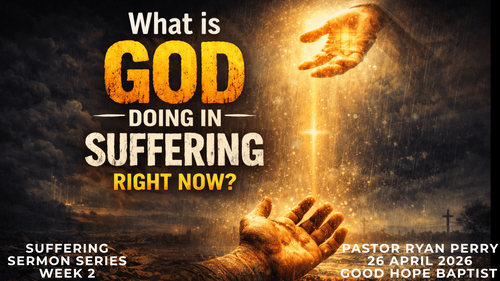
Suffering Series Sermon 2: What is God doing in suffering right now?
Pastor Ryan Perry
Good Hope Baptist Church
26 April 2026
Key Verses:
Psalm 115:3; Deuteronomy 32:4; Genesis 1:26; Genesis 9:6; James 3:9; Genesis 3:5; Romans 1; Romans 6:16; John 8:44; John 10:10; Colossians 1:15; Philippians 2; Romans 8:29; Colossians 3:10; Genesis 50:20; Acts 2:23; Romans 8:28; Romans 5:3–4; James 1:3; John 14:1; John 14:16; John 14:27; John 15:1–2; John 15:4–5; John 15:8; John 15:18; Romans 8:18; Revelation 21:4; Revelation 22:3–5; Ephesians 1; Psalm 34:18
I. God Is Sovereign and Perfectly Just
Psalm 115:3 – God rules over all things—nothing exists outside His authority.
That means nothing exists outside his rule. Yet sovereignty must always be joined to character.
Deuteronomy 32:4 – His rule is never unjust—His ways are always justice (mišpāṭ).
The Hebrew word for justice is mišpāṭ, meaning righteous judgment, right order, things set rightly according to truth. God never rules crookedly. He never governs unjustly. He never acts with evil motives.
Today we ask the question: If suffering is happening right now, what is God doing?
Many assume suffering means: God is absent, or God is powerless, or God is just cruel.
Scripture says none of those are true. Instead, Scripture repeatedly illustrates that God is present. God is ruling, and God is restoring.
Today, we will walk through five biblical movements. To understand suffering, we must begin before suffering existed.
II. Humanity Was Created as God’s Image Bearers
Genesis 1:26 – Humanity was made in God’s image (ṣelem / eikōn) to reflect and represent Him.
The Hebrew word for image is ṣelem. It often refers to an image, representation, or visible figure. The Greek Old Testament, the Septuagint (LXX), translates it as eikōn, the same word later used of Christ in the New Testament.
Plainly spoken, this is what the Bible means when it says humanity was made in the image of God.
God is invisible, yet he chose human beings to visibly reflect his rule, goodness, wisdom, and care inside creation. That does not mean we are gods, equal to God, or worthy of worship. It means we were given a purpose and a calling, unlike the rest of creation.
So what is humanity? Humanity is the part of creation uniquely made to know God, love God, reflect God, and represent God on the earth.
Why were we created? We were created to live in relationship with God, live under his good authority, care for the world he made, love one another, and show what God is like through the way we live.
That is what it means to be image bearers of God.
We were made with purpose, not by accident. We were made to belong to God; we were made to reflect his goodness; we were made to carry responsibility; we were made to bring order, not chaos; we were made to worship the Creator, not created things; we were made to rule under God, not replace God. Humanity was meant to be creation’s royal servant race under the true King.
To an ancient Hebrew, worship meant rightly ordering your whole life under the God who made you. It was not mainly about a music set. It was about allegiance, trust, obedience, love, gratitude, and living in covenant relationship with Yahweh.
Worship meant recognizing who is truly God, knowing we are not God, receiving life as a gift, trusting God’s wisdom above our own, obeying God’s guidance, giving thanks for the provision God provides, structuring life around God’s presence, and refusing rival gods and false masters.
So when the Bible says humanity was made to worship the Creator, it means humans were made to live with God at the center of everything.
In Modern Language, we were made to have the right “center of gravity.” Everyone organizes life around something. Today, people may center life around: money, success, pleasure, politics, social media image, relationships, self-expression, technology, and or control.
The Bible says all of those make terrible gods. A Hebrew would say worship is what you build your life around.
If an ambassador ignores the king, serves another nation, and makes up his own laws, he has failed his purpose.
That is idolatry. Meaning, idolatry is not only bowing before a statue. At its deepest level, idolatry is giving ultimate loyalty, trust, obedience, and identity to something other than the true King.
It is the rejection of rightful rule and the transfer of allegiance to a false master.
So, in the image-bearer/ambassador picture, idolatry is: serving another throne, representing another kingdom, living by another authority, taking guidance from another source, and seeking life from what cannot give life.
Biblically, idolatry happens whenever creation takes the place of the Creator.
That can be a carved image, but it can also be: money as savior, power as security, pleasure as purpose, self as god, culture as truth, success as identity, or politics as hope.
So the deeper definition is: Idolatry is misdirected worship that reshapes a person away from God’s design.
If we faithfully represent the king/God, we fulfill our role and our purpose for existing.
That is worship. So a Hebrew would hear: You were made to represent Yahweh by living under Yahweh.
This is why idolatry is such a serious sin in Scripture. Humans were made to rule creation under God, not bow down to creation in place of God. When image bearers worship idols, everything is reversed. The steward kneels before the object he was meant to govern. The living person bows before a dead thing. The one made to reflect God begins reflecting what is beneath him instead.
That is why Psalms 115 says those who make idols become like them. Worship shapes the worshiper.
III. Sin Distorted the Image and Introduced Disorder
Sin did not erase the image of God in humanity, but it distorted it. People still possess dignity, value, and responsibility, yet instead of reflecting God clearly, humanity often reflects pride, selfishness, violence, lies, and rebellion.
That is why Jesus Christ is so important.
Colossians 1:15 says Christ is the image of the invisible God. He is humanity as humanity was meant to be. Where Adam failed, Christ obeyed. Where humanity bowed wrongly, Christ worshiped rightly. Where humanity ruled selfishly, Christ ruled through service and love.
Through salvation (God rescuing people from what is destroying them and restoring them to right life under him), therefore God is restoring broken image-bearers into the likeness of His Son, Jesus.
The word likeness is demût, meaning resemblance, correspondence, analogy.
Together with image-bearers, they teach this: Humanity was created to visibly represent the invisible God within creation. Not as little gods. Not as equals with God. But as creatures commissioned to reflect him.
Back to Scripture, the very next line in Genesis 1:26 states ...and let them have dominion.
The Hebrew word is rādâ, meaning to rule, govern, exercise authority. Notice the order. Image first. Rule second. Meaning our authority was never autonomous. It was a representative authority, so being an ambassador.
Genesis 2 places humanity in the Garden of Eden.
When God first made humanity, he did not create us for burnout, anxiety, violence, confusion, broken relationships, or meaningless work. He created people for a healthy, purposeful life.
The Garden of Eden represents the world as it was meant to be: close to God, safe, meaningful, abundant, peaceful, ordered, and full of life.
When the Bible says Adam was placed there “to work it and keep it,” it means people were created to contribute, build, care, protect, and make good things, things that were already created and planted to flourish.
So from the very beginning, humanity’s purpose was not to sit around doing nothing, nor to dominate everything selfishly. Humanity was created to help the world flourish under God’s rule
What This Means About Suffering: Suffering feels wrong to use because it is wrong. Deep down, people know pain, injustice, death, betrayal, and chaos are not how life should be.
That instinct exists because suffering was not in the original design.
Then Genesis 3 begins with a question: Did God actually say?
That matters because the first attack was not physical. The serpent did not begin by hurting anyone. He began by making people doubt God’s word.
The Israelites would understand something very important here: When trust in God’s voice is broken, everything else begins to break after it.
The serpent’s message was simple: God is holding something back from you, God cannot be fully trusted, you should decide good and evil for yourself, and you do not need to remain under God’s authority.
Then he says: You will be like God.
The irony is that humanity was already made in God’s image. They already had honor, purpose, dignity, and authority under God. The temptation was to seize independently what had already been given relationally.
That is still how sin works. People often reach the wrong way for what God made them for, rightly.
They seek identity without God, wisdom without God, power without God, freedom without God, blessing without obedience, and life without the giver of life.
Humanity chose autonomy over trust.
That means they chose self-rule instead of living under God’s wisdom. The result was distortion. What had been ordered became disordered.
Fellowship with God turned into hiding from God, truth became blame and excuses.
Meaningful work became a painful struggle against creation itself, and life became touched by death.
The curse in Genesis is the undoing of blessing. It is creation no longer functioning as smoothly as it was meant to under God’s order.
Was the image of God lost? No. The Israelites would understand that humanity still remained human and still accountable to God.
Genesis 9:6 – still speaks of humanity made in God’s image.
James 3:9 – says humans are still made in God’s likeness.
So the dignity remained, but the reflection was damaged.
Think of a mirror cracked but still showing an image. That is why people can do both great good and terrible evil.
We can build hospitals or battlefields, heal wounds or cause them, love faithfully or betray deeply, create beauty or unleash destruction.
The image remains. The alignment is broken.
God made creatures to live under his wisdom. The serpent embraced deception and imagined self-exaltation apart from God. Once corrupted, he spread the same lie to others.
That is how evil advances: truth is abandoned, pride rises, and deception presents rebellion as freedom.
Why this matters: the serpent could not create anything good. He could only twist what God made good.
That is always the nature of evil. Evil does not create life. It corrupts life. It does not create truth. It twists the truth. It does not create beauty. It distorts beauty.
Scripture teaches a deep principle: We become shaped by what rules us.
Romans 6:16 – You are slaves of the one whom you obey.
The Greek word is doulos, bondservant, one under mastery. Everyone serves some lord.
John 8:44 – Jesus says: You are of your father the devil.
He does not mean created by Satan. He means morally aligned with his desires.
Romans 1 says humanity exchanged the glory of God for images.
The Greek word for exchanged is allassō, to trade one thing for another.
Humanity traded worship of the Creator for created things. Then everything bends out of shape. False worship creates false humanity. That is why suffering spreads, greed devours, lust uses, pride crushes, hatred destroys, and deceit wounds.
IV. Two Kingdoms: Destruction vs. Life
John 10:10 – The enemy’s purpose: steal, kill, destroy.
But Jesus says I came that they may have life. Life is zōē, not mere breathing, but fullness of life as God intends.
This dichotomy illustrates two kingdoms, two directions, and two outcomes. God/Jesus has our best interests at heart; Satan, on the other hand, wants to sell it and destroy us in the process.
V. God Is Restoring His Image Through Christ
God did not abandon his image bearers. He entered the chaotic world that was hostile towards Him.
Colossians 1:15 – Jesus is the perfect image (eikōn) of God.
Jesus is the perfect visible revelation of the invisible God. Where Adam failed, Christ obeyed. Where humanity grasped, Christ humbled Himself.
Philippians 2 – Christ emptied himself and took the form of a servant.
That is true kingship. That is being an ambassador of God. That is worship.
Romans 8:29 – To be conformed to the image of his Son.
Conformed is symmorphos, shaped into the same form.
God is reshaping broken humanity into Christlike humanity, meaning true worshippers, image-bearers/ambassadors of the Most High God.
Colossians 3:10 – The new self… being renewed.
VI. God Works Through Suffering for Redemption and Formation
We have already established that suffering entered through the fall and through a creation now groaning under curse. We have already shown that pain was not the original design of Eden. Humanity was created for communion with God, meaningful work, ordered flourishing, and life under his reign. So let us move deeper now.
The question is no longer merely, “Where did suffering come from?” The question is, “What is God doing when suffering comes?”
Scripture does not teach that God stands distant, helpless, or absent. It also does not teach that God delights in pain for its own sake. It teaches that God is sovereign, present, wise, and able to bring holy purpose into what a broken world meant for harm.
Genesis 50:20 – Joseph said to the brothers who betrayed him, “You meant evil against me, but God meant it for good.”
Notice the text carefully. Their act was evil. God did not rename evil as good. God overruled evil for good. Human sin was real. Divine sovereignty was greater.
That same pattern reaches its highest point at the cross.
Acts 2:23 – Peter declared of Jesus Christ, This Jesus, delivered up according to the definite plan and foreknowledge of God, you crucified and killed by the hands of lawless men.
Lawless men acted wickedly. God accomplished redemption through the very event they meant for destruction.
This means the people of God never say evil is good. We say God is greater than evil.
Romans 8:28 – That is why Romans declares, For those who love God all things work together for good.
It does not say all things are good. It says God works in all things for good.
Betrayal is not good. Disease is not good. Injustice is not good. Death is not good. Yet none of them are beyond God’s authority to redeem, transform, and overrule.
What good does God bring? Scripture gives substance, not clichés.
Romans 5:3–4 – Suffering produces endurance, and endurance produces character, and character produces hope.
James 1:3 – The testing of your faith produces steadfastness.
Endurance means weight that once crushed you no longer rules you. Character means tested integrity instead of shallow religion. Hope means confidence in God that survives dark seasons.
John 14 and 15 take us even deeper, because Jesus does not explain suffering merely as something to endure. He explains it through relationship with him, the presence of the Spirit, and fruitfulness under pressure.
Jesus speaks these words on the night before the cross. He is preparing his disciples for grief, confusion, fear, and persecution. He knows suffering is coming, yet his message is not panic. His message is trust.
John 14:1 – He says, “Let not your hearts be troubled. Believe in God; believe also in me”
Christ does not deny pain. He commands that pain not become master of the heart.
John 14:27 – He says again, “Peace I leave with you; my peace I give to you. Not as the world gives do I give to you. Let not your hearts be troubled, neither let them be afraid”
The world’s peace depends on circumstances being stable. Christ’s peace depends on his presence being stable. One disappears when life shakes. The other can remain while life shakes.
John 14:16 – Then Jesus gives this promise: “I will ask the Father, and he will give you another Helper, to be with you forever”
In suffering, believers are not abandoned to private strength. The Holy Spirit is present as Helper, Comforter, and Advocate.
This means suffering for the Christian is never solitary suffering.
John 15:1–2 – Then Jesus says, “I am the true vine, and my Father is the vinedresser… every branch that does bear fruit he prunes, that it may bear more fruit”
Pruning is not punishment of a dead branch. Pruning is care for a living branch. The branch is already connected. The cut is not to destroy life, but to increase life.
Some pain in the believer’s life is not wrath. Some pain is the painful removal of what hinders fruitfulness. God may cut pride, false dependence, shallow loves, wasted habits, divided loyalties, hidden idols, or self-trust. The cut hurts, but the purpose is fruit.
John 15:4–5 – Jesus says, “Abide in me, and I in you… apart from me you can do nothing”
Many ask, “How do I survive suffering?” Jesus first asks, “Will you remain in me during suffering?” Abiding means continuing in prayer, obedience, trust, worship, and fellowship when emotions are unstable.
John 15:18 – Jesus also says, “If the world hates you, know that it has hated me before it hated you”
Some suffering comes not from failure, but from faithfulness. Truth has a cost in a false age. Holiness has a cost in a corrupt age. Loyalty to Christ has a cost in a rebellious age.
Yet even there suffering is not wasted.
John 15:8 – Jesus says, “By this my Father is glorified, that you bear much fruit”
Fruit means love when wronged. Peace when shaken. Obedience when costly. Faith when confused. Witness when opposed. Perseverance when weary.
God is not the author of the ashes. God is the redeemer of ashes. What enters your life through a fallen world does not enter beyond the reach of a sovereign God.
The resurrection proves it. Death took Christ into the tomb. God raised him in glory. If God can turn a cross into salvation and a tomb into victory, then he can take what is wounding you now and make it serve a higher end.
Suffering may be real, but it is not ultimate. Pain may be present, but it is not sovereign. God alone is sovereign.
VII. God Is Moving History Toward Final Restoration
The present world is not the final world.
Romans 8:18 – he sufferings of this present time are not worth comparing with the glory to be revealed.
Glory is doxa, weight, splendor, radiant worth.
Creation waits for restored humanity.
Revelation 22:3–5 – No longer will there be anything accursed… they will see his face… and they will reign forever and ever.
Do you hear Genesis being healed? Curse removed, presence restored, servants serving, and reign restored.
His name will be on their foreheads. That means ownership, identity, and belonging.
The beast marks counterfeit humanity. God seals redeemed humanity.
Ephesians 1 – believers are sealed with the Holy Spirit.
The Spirit is the mark of belonging now.
Revelation 21:4 – He will wipe away every tear.
Pain has an ending. Death has an ending. Loss has an ending. Tears have an ending.
So what is God doing in suffering right now? He is doing what he has always done. He is reclaiming creation. He is restoring his image bearers. He is defeating evil through Christ.
He is forming saints in trials. Suffering is not good in itself, yet God can use hardship in a fallen world to build endurance, deepen faith, expose false trusts, and shape believers into the likeness of Christ.
He is moving history toward glory. Though evil and chaos are real, history is not random. God is guiding all things toward Christ’s return, final justice, resurrection, and renewed creation.
The cross proves God entered suffering. In Jesus Christ, God stepped into human pain, rejection, injustice, and death to redeem the world from within.
The resurrection proves evil will lose. Christ rose bodily from the grave, showing that death, sin, and darkness do not have final authority.
The Spirit proves restoration has begun. God gives the Holy Spirit now to renew hearts, strengthen believers, produce holiness, and bring future life into the present.
Glory proves the story ends well. The end is not endless suffering, but resurrection life, renewed creation, justice fulfilled, tears removed, and full fellowship with God.
Psalm 34:18 – The Lord is near to the brokenhearted.
Near in Hebrew thought is covenant presence, not distant awareness.
Come to Christ today.
The perfect Eikōn restores broken image bearers.
Trust him.
Because salvation does not always remove suffering now, but it guarantees suffering will not have the final word.
Jesus will.
Conclusion: What Is God Doing Right Now?
Final Call
Pastor Ryan Perry
Good Hope Baptist Church
26 April 2026
Key Verses:
Psalm 115:3; Deuteronomy 32:4; Genesis 1:26; Genesis 9:6; James 3:9; Genesis 3:5; Romans 1; Romans 6:16; John 8:44; John 10:10; Colossians 1:15; Philippians 2; Romans 8:29; Colossians 3:10; Genesis 50:20; Acts 2:23; Romans 8:28; Romans 5:3–4; James 1:3; John 14:1; John 14:16; John 14:27; John 15:1–2; John 15:4–5; John 15:8; John 15:18; Romans 8:18; Revelation 21:4; Revelation 22:3–5; Ephesians 1; Psalm 34:18
I. God Is Sovereign and Perfectly Just
Psalm 115:3 – God rules over all things—nothing exists outside His authority.
That means nothing exists outside his rule. Yet sovereignty must always be joined to character.
Deuteronomy 32:4 – His rule is never unjust—His ways are always justice (mišpāṭ).
The Hebrew word for justice is mišpāṭ, meaning righteous judgment, right order, things set rightly according to truth. God never rules crookedly. He never governs unjustly. He never acts with evil motives.
Today we ask the question: If suffering is happening right now, what is God doing?
Many assume suffering means: God is absent, or God is powerless, or God is just cruel.
Scripture says none of those are true. Instead, Scripture repeatedly illustrates that God is present. God is ruling, and God is restoring.
Today, we will walk through five biblical movements. To understand suffering, we must begin before suffering existed.
II. Humanity Was Created as God’s Image Bearers
Genesis 1:26 – Humanity was made in God’s image (ṣelem / eikōn) to reflect and represent Him.
The Hebrew word for image is ṣelem. It often refers to an image, representation, or visible figure. The Greek Old Testament, the Septuagint (LXX), translates it as eikōn, the same word later used of Christ in the New Testament.
Plainly spoken, this is what the Bible means when it says humanity was made in the image of God.
God is invisible, yet he chose human beings to visibly reflect his rule, goodness, wisdom, and care inside creation. That does not mean we are gods, equal to God, or worthy of worship. It means we were given a purpose and a calling, unlike the rest of creation.
So what is humanity? Humanity is the part of creation uniquely made to know God, love God, reflect God, and represent God on the earth.
Why were we created? We were created to live in relationship with God, live under his good authority, care for the world he made, love one another, and show what God is like through the way we live.
That is what it means to be image bearers of God.
We were made with purpose, not by accident. We were made to belong to God; we were made to reflect his goodness; we were made to carry responsibility; we were made to bring order, not chaos; we were made to worship the Creator, not created things; we were made to rule under God, not replace God. Humanity was meant to be creation’s royal servant race under the true King.
To an ancient Hebrew, worship meant rightly ordering your whole life under the God who made you. It was not mainly about a music set. It was about allegiance, trust, obedience, love, gratitude, and living in covenant relationship with Yahweh.
Worship meant recognizing who is truly God, knowing we are not God, receiving life as a gift, trusting God’s wisdom above our own, obeying God’s guidance, giving thanks for the provision God provides, structuring life around God’s presence, and refusing rival gods and false masters.
So when the Bible says humanity was made to worship the Creator, it means humans were made to live with God at the center of everything.
In Modern Language, we were made to have the right “center of gravity.” Everyone organizes life around something. Today, people may center life around: money, success, pleasure, politics, social media image, relationships, self-expression, technology, and or control.
The Bible says all of those make terrible gods. A Hebrew would say worship is what you build your life around.
If an ambassador ignores the king, serves another nation, and makes up his own laws, he has failed his purpose.
That is idolatry. Meaning, idolatry is not only bowing before a statue. At its deepest level, idolatry is giving ultimate loyalty, trust, obedience, and identity to something other than the true King.
It is the rejection of rightful rule and the transfer of allegiance to a false master.
So, in the image-bearer/ambassador picture, idolatry is: serving another throne, representing another kingdom, living by another authority, taking guidance from another source, and seeking life from what cannot give life.
Biblically, idolatry happens whenever creation takes the place of the Creator.
That can be a carved image, but it can also be: money as savior, power as security, pleasure as purpose, self as god, culture as truth, success as identity, or politics as hope.
So the deeper definition is: Idolatry is misdirected worship that reshapes a person away from God’s design.
If we faithfully represent the king/God, we fulfill our role and our purpose for existing.
That is worship. So a Hebrew would hear: You were made to represent Yahweh by living under Yahweh.
This is why idolatry is such a serious sin in Scripture. Humans were made to rule creation under God, not bow down to creation in place of God. When image bearers worship idols, everything is reversed. The steward kneels before the object he was meant to govern. The living person bows before a dead thing. The one made to reflect God begins reflecting what is beneath him instead.
That is why Psalms 115 says those who make idols become like them. Worship shapes the worshiper.
III. Sin Distorted the Image and Introduced Disorder
Sin did not erase the image of God in humanity, but it distorted it. People still possess dignity, value, and responsibility, yet instead of reflecting God clearly, humanity often reflects pride, selfishness, violence, lies, and rebellion.
That is why Jesus Christ is so important.
Colossians 1:15 says Christ is the image of the invisible God. He is humanity as humanity was meant to be. Where Adam failed, Christ obeyed. Where humanity bowed wrongly, Christ worshiped rightly. Where humanity ruled selfishly, Christ ruled through service and love.
Through salvation (God rescuing people from what is destroying them and restoring them to right life under him), therefore God is restoring broken image-bearers into the likeness of His Son, Jesus.
The word likeness is demût, meaning resemblance, correspondence, analogy.
Together with image-bearers, they teach this: Humanity was created to visibly represent the invisible God within creation. Not as little gods. Not as equals with God. But as creatures commissioned to reflect him.
Back to Scripture, the very next line in Genesis 1:26 states ...and let them have dominion.
The Hebrew word is rādâ, meaning to rule, govern, exercise authority. Notice the order. Image first. Rule second. Meaning our authority was never autonomous. It was a representative authority, so being an ambassador.
Genesis 2 places humanity in the Garden of Eden.
When God first made humanity, he did not create us for burnout, anxiety, violence, confusion, broken relationships, or meaningless work. He created people for a healthy, purposeful life.
The Garden of Eden represents the world as it was meant to be: close to God, safe, meaningful, abundant, peaceful, ordered, and full of life.
When the Bible says Adam was placed there “to work it and keep it,” it means people were created to contribute, build, care, protect, and make good things, things that were already created and planted to flourish.
So from the very beginning, humanity’s purpose was not to sit around doing nothing, nor to dominate everything selfishly. Humanity was created to help the world flourish under God’s rule
What This Means About Suffering: Suffering feels wrong to use because it is wrong. Deep down, people know pain, injustice, death, betrayal, and chaos are not how life should be.
That instinct exists because suffering was not in the original design.
Then Genesis 3 begins with a question: Did God actually say?
That matters because the first attack was not physical. The serpent did not begin by hurting anyone. He began by making people doubt God’s word.
The Israelites would understand something very important here: When trust in God’s voice is broken, everything else begins to break after it.
The serpent’s message was simple: God is holding something back from you, God cannot be fully trusted, you should decide good and evil for yourself, and you do not need to remain under God’s authority.
Then he says: You will be like God.
The irony is that humanity was already made in God’s image. They already had honor, purpose, dignity, and authority under God. The temptation was to seize independently what had already been given relationally.
That is still how sin works. People often reach the wrong way for what God made them for, rightly.
They seek identity without God, wisdom without God, power without God, freedom without God, blessing without obedience, and life without the giver of life.
Humanity chose autonomy over trust.
That means they chose self-rule instead of living under God’s wisdom. The result was distortion. What had been ordered became disordered.
Fellowship with God turned into hiding from God, truth became blame and excuses.
Meaningful work became a painful struggle against creation itself, and life became touched by death.
The curse in Genesis is the undoing of blessing. It is creation no longer functioning as smoothly as it was meant to under God’s order.
Was the image of God lost? No. The Israelites would understand that humanity still remained human and still accountable to God.
Genesis 9:6 – still speaks of humanity made in God’s image.
James 3:9 – says humans are still made in God’s likeness.
So the dignity remained, but the reflection was damaged.
Think of a mirror cracked but still showing an image. That is why people can do both great good and terrible evil.
We can build hospitals or battlefields, heal wounds or cause them, love faithfully or betray deeply, create beauty or unleash destruction.
The image remains. The alignment is broken.
God made creatures to live under his wisdom. The serpent embraced deception and imagined self-exaltation apart from God. Once corrupted, he spread the same lie to others.
That is how evil advances: truth is abandoned, pride rises, and deception presents rebellion as freedom.
Why this matters: the serpent could not create anything good. He could only twist what God made good.
That is always the nature of evil. Evil does not create life. It corrupts life. It does not create truth. It twists the truth. It does not create beauty. It distorts beauty.
Scripture teaches a deep principle: We become shaped by what rules us.
Romans 6:16 – You are slaves of the one whom you obey.
The Greek word is doulos, bondservant, one under mastery. Everyone serves some lord.
John 8:44 – Jesus says: You are of your father the devil.
He does not mean created by Satan. He means morally aligned with his desires.
Romans 1 says humanity exchanged the glory of God for images.
The Greek word for exchanged is allassō, to trade one thing for another.
Humanity traded worship of the Creator for created things. Then everything bends out of shape. False worship creates false humanity. That is why suffering spreads, greed devours, lust uses, pride crushes, hatred destroys, and deceit wounds.
IV. Two Kingdoms: Destruction vs. Life
John 10:10 – The enemy’s purpose: steal, kill, destroy.
But Jesus says I came that they may have life. Life is zōē, not mere breathing, but fullness of life as God intends.
This dichotomy illustrates two kingdoms, two directions, and two outcomes. God/Jesus has our best interests at heart; Satan, on the other hand, wants to sell it and destroy us in the process.
V. God Is Restoring His Image Through Christ
God did not abandon his image bearers. He entered the chaotic world that was hostile towards Him.
Colossians 1:15 – Jesus is the perfect image (eikōn) of God.
Jesus is the perfect visible revelation of the invisible God. Where Adam failed, Christ obeyed. Where humanity grasped, Christ humbled Himself.
Philippians 2 – Christ emptied himself and took the form of a servant.
That is true kingship. That is being an ambassador of God. That is worship.
Romans 8:29 – To be conformed to the image of his Son.
Conformed is symmorphos, shaped into the same form.
God is reshaping broken humanity into Christlike humanity, meaning true worshippers, image-bearers/ambassadors of the Most High God.
Colossians 3:10 – The new self… being renewed.
VI. God Works Through Suffering for Redemption and Formation
We have already established that suffering entered through the fall and through a creation now groaning under curse. We have already shown that pain was not the original design of Eden. Humanity was created for communion with God, meaningful work, ordered flourishing, and life under his reign. So let us move deeper now.
The question is no longer merely, “Where did suffering come from?” The question is, “What is God doing when suffering comes?”
Scripture does not teach that God stands distant, helpless, or absent. It also does not teach that God delights in pain for its own sake. It teaches that God is sovereign, present, wise, and able to bring holy purpose into what a broken world meant for harm.
Genesis 50:20 – Joseph said to the brothers who betrayed him, “You meant evil against me, but God meant it for good.”
Notice the text carefully. Their act was evil. God did not rename evil as good. God overruled evil for good. Human sin was real. Divine sovereignty was greater.
That same pattern reaches its highest point at the cross.
Acts 2:23 – Peter declared of Jesus Christ, This Jesus, delivered up according to the definite plan and foreknowledge of God, you crucified and killed by the hands of lawless men.
Lawless men acted wickedly. God accomplished redemption through the very event they meant for destruction.
This means the people of God never say evil is good. We say God is greater than evil.
Romans 8:28 – That is why Romans declares, For those who love God all things work together for good.
It does not say all things are good. It says God works in all things for good.
Betrayal is not good. Disease is not good. Injustice is not good. Death is not good. Yet none of them are beyond God’s authority to redeem, transform, and overrule.
What good does God bring? Scripture gives substance, not clichés.
Romans 5:3–4 – Suffering produces endurance, and endurance produces character, and character produces hope.
James 1:3 – The testing of your faith produces steadfastness.
Endurance means weight that once crushed you no longer rules you. Character means tested integrity instead of shallow religion. Hope means confidence in God that survives dark seasons.
John 14 and 15 take us even deeper, because Jesus does not explain suffering merely as something to endure. He explains it through relationship with him, the presence of the Spirit, and fruitfulness under pressure.
Jesus speaks these words on the night before the cross. He is preparing his disciples for grief, confusion, fear, and persecution. He knows suffering is coming, yet his message is not panic. His message is trust.
John 14:1 – He says, “Let not your hearts be troubled. Believe in God; believe also in me”
Christ does not deny pain. He commands that pain not become master of the heart.
John 14:27 – He says again, “Peace I leave with you; my peace I give to you. Not as the world gives do I give to you. Let not your hearts be troubled, neither let them be afraid”
The world’s peace depends on circumstances being stable. Christ’s peace depends on his presence being stable. One disappears when life shakes. The other can remain while life shakes.
John 14:16 – Then Jesus gives this promise: “I will ask the Father, and he will give you another Helper, to be with you forever”
In suffering, believers are not abandoned to private strength. The Holy Spirit is present as Helper, Comforter, and Advocate.
This means suffering for the Christian is never solitary suffering.
John 15:1–2 – Then Jesus says, “I am the true vine, and my Father is the vinedresser… every branch that does bear fruit he prunes, that it may bear more fruit”
Pruning is not punishment of a dead branch. Pruning is care for a living branch. The branch is already connected. The cut is not to destroy life, but to increase life.
Some pain in the believer’s life is not wrath. Some pain is the painful removal of what hinders fruitfulness. God may cut pride, false dependence, shallow loves, wasted habits, divided loyalties, hidden idols, or self-trust. The cut hurts, but the purpose is fruit.
John 15:4–5 – Jesus says, “Abide in me, and I in you… apart from me you can do nothing”
Many ask, “How do I survive suffering?” Jesus first asks, “Will you remain in me during suffering?” Abiding means continuing in prayer, obedience, trust, worship, and fellowship when emotions are unstable.
John 15:18 – Jesus also says, “If the world hates you, know that it has hated me before it hated you”
Some suffering comes not from failure, but from faithfulness. Truth has a cost in a false age. Holiness has a cost in a corrupt age. Loyalty to Christ has a cost in a rebellious age.
Yet even there suffering is not wasted.
John 15:8 – Jesus says, “By this my Father is glorified, that you bear much fruit”
Fruit means love when wronged. Peace when shaken. Obedience when costly. Faith when confused. Witness when opposed. Perseverance when weary.
God is not the author of the ashes. God is the redeemer of ashes. What enters your life through a fallen world does not enter beyond the reach of a sovereign God.
The resurrection proves it. Death took Christ into the tomb. God raised him in glory. If God can turn a cross into salvation and a tomb into victory, then he can take what is wounding you now and make it serve a higher end.
Suffering may be real, but it is not ultimate. Pain may be present, but it is not sovereign. God alone is sovereign.
- Christ gives peace, presence, and purpose in suffering.
- The Spirit is our Helper.
- Pruning produces fruit.
- Abiding sustains life.
- Some suffering comes through faithfulness.
VII. God Is Moving History Toward Final Restoration
The present world is not the final world.
Romans 8:18 – he sufferings of this present time are not worth comparing with the glory to be revealed.
Glory is doxa, weight, splendor, radiant worth.
Creation waits for restored humanity.
Revelation 22:3–5 – No longer will there be anything accursed… they will see his face… and they will reign forever and ever.
Do you hear Genesis being healed? Curse removed, presence restored, servants serving, and reign restored.
His name will be on their foreheads. That means ownership, identity, and belonging.
The beast marks counterfeit humanity. God seals redeemed humanity.
Ephesians 1 – believers are sealed with the Holy Spirit.
The Spirit is the mark of belonging now.
Revelation 21:4 – He will wipe away every tear.
Pain has an ending. Death has an ending. Loss has an ending. Tears have an ending.
So what is God doing in suffering right now? He is doing what he has always done. He is reclaiming creation. He is restoring his image bearers. He is defeating evil through Christ.
He is forming saints in trials. Suffering is not good in itself, yet God can use hardship in a fallen world to build endurance, deepen faith, expose false trusts, and shape believers into the likeness of Christ.
He is moving history toward glory. Though evil and chaos are real, history is not random. God is guiding all things toward Christ’s return, final justice, resurrection, and renewed creation.
The cross proves God entered suffering. In Jesus Christ, God stepped into human pain, rejection, injustice, and death to redeem the world from within.
The resurrection proves evil will lose. Christ rose bodily from the grave, showing that death, sin, and darkness do not have final authority.
The Spirit proves restoration has begun. God gives the Holy Spirit now to renew hearts, strengthen believers, produce holiness, and bring future life into the present.
Glory proves the story ends well. The end is not endless suffering, but resurrection life, renewed creation, justice fulfilled, tears removed, and full fellowship with God.
Psalm 34:18 – The Lord is near to the brokenhearted.
Near in Hebrew thought is covenant presence, not distant awareness.
Come to Christ today.
The perfect Eikōn restores broken image bearers.
Trust him.
Because salvation does not always remove suffering now, but it guarantees suffering will not have the final word.
Jesus will.
Conclusion: What Is God Doing Right Now?
- God is ruling — Psalm 115:3
- God is just — Deuteronomy 32:4
- God is present — Psalm 34:18
- God is restoring His image — Romans 8:29
- God is working through suffering — Romans 8:28
- God is forming His people — James 1:3
- God is bringing all things to glory — Revelation 21:4
Final Call
- Suffering does not mean God is absent.
- Suffering does not mean God is finished.
- Suffering means God is at work in a world He is redeeming.
Posted in Sermon Notes
Recent
Archive
2026
January
February
March
Sermon Study Guide 01 March 2026Parent Discipleship Guide 01 March 2026Sermon Notes 08 March 2026Devotional Guide 08 March 2026Parent Discipleship Guide 08 March 2026Bulletin 08 March 2026Bulletin 15 March 2026Praises & Prayers 15 March 2026 Sermon Notes 15 March 2026Parent Discipleship Guide 15 March 2026Devotional Guide 15 March 2026Sermon Notes 22 March 2026Devotional Guide 22 March 2026Parent Discipleship Guide 22 March 2026Bulletin 22 March 2026Sermon Notes 29 March 2026Devotional Guide 29 March 2026Parent Discipleship Guide 29 March 2026Bulletin 29 March 2026
April
Sermon Notes 05 April 2026Devotional Guide 05 April 2026Parent Discipleship Guide 05 April 2026Bulletin 05 April 2026Sermon Notes 12 April 2026Bulletin 12 April 2026Sermon Notes 19 April 2026Parent Discipleship Guide 19 April 2026 Devotional Guide 19 April 2026Bulletin 19 April 2026Bulletin 26 April 2026Sermon Notes 26 April 2026Devotional Guide 26 April 2026Parent Discipleship Guide 26 April 2026
2025
July
August
September
October
November