Sermon Notes 15 March 2026

SERMON NOTES 15 MARCH 2026
Passover 2026 Sermon 3:
Pesach - Why Did The Lamb Have To Die?
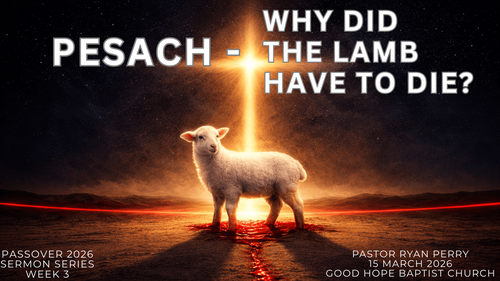
PASSOVER 2026 Sermon 3: Pesakh – Why Did the Lamb Have to Die?
Pastor Ryan Perry
Good Hope Baptist Church
15 March 2026
Primary Texts
In this series we are walking toward Easter by entering the story of Passover – the story God gave long before Jesus was born, to teach His people how He saves.
Last week, we saw how God saves. We saw that Passover is not about God bypassing His people. It is about God standing between His people and death.
God does not remove judgment. He provides a covering that judgment cannot penetrate, which is Himself!
But that truth raises questions we cannot ignore. Why does it require blood? If God is holy, why can’t He simply forgive without a cost?
Today, we ask the question Passover itself forces us to ask, “Why did a lamb have to die?”
Thesis:
Thesis: Passover taught Israel how salvation works, long before Jesus arrived. This is where Passover becomes uncomfortable. Covering is never free. A lamb had to die… because Love chose to stand in your place.
I. The Passover Lamb
Exodus 12:5–6 – God’s instructions in Exodus were precise.
God does not accept substitutes at random. He does not accept grain, effort, or regret. He requires life.
Leviticus 17:11 – Scripture explains why. Blood is not magic. Blood represents life. When blood is shed, life is given.
Passover teaches us that deliverance always comes at the cost of a life.
Many people assume God simply overlooked sin in Egypt. He did not. Judgment still came. Death still passed through the land.
Ezekiel 18:4 – Because God set creation apart for life and covenant, disorder cannot go unanswered.
The question was never whether judgment would fall. The question was where it would fall. Either death would take the firstborn or death would take the lamb.
God did not cancel judgment. He redirected it. This is substitution. The innocent stands in the place of the guilty.
God did not choose a lamb by accident. Lambs are defenseless. They do not fight back. They do not resist.
II. The Lamb as the Suffering Substitute
Isaiah 53:7 – The lamb does not argue innocence. The lamb absorbs what it did not deserve.
Passover taught Israel how salvation works, long before Jesus arrived.
This is where Passover becomes uncomfortable. Covering is never free.
In every case, life stands between judgment and people.
1 Peter 2:24 - Judgment does not disappear. It just does not fall on those who are covered.
This is the turning point of Passover. God does not merely require a lamb. He provides one.
III. The Fulfillment in Christ
Isaiah 53:4–6; Romans 5:8 – The lamb dies so the people live. God steps into the place of judgment Himself.
Every year, Israel repeated the same question, “Why must another lamb die?” Because every lamb was temporary. Every sacrifice pointed forward.
Until one day, John the Baptist saw Jesus and said, “Behold, the Lamb of God, who takes away the sin of the world.”
Invitation
Some of us still believe protection must be earned.
Passover says protection is received.
The question has never been whether judgment exists.
The question is whether you are trusting God’s provision.
Are you under the blood?
Next week, we will see how Jesus fulfills Passover at the table when bread is broken, when the cup is lifted, and when He says, “This is my body… this is my blood.”
But today, hear this clearly:
A lamb had to die… because love chose to stand in your place.
Pastor Ryan Perry
Good Hope Baptist Church
15 March 2026
Primary Texts
- Exodus 12:1–13
The institution of Passover and the promise:
“When I see the blood, I will pass over you.” - Leviticus 17:11
“For the life of the flesh is in the blood… it is the blood that makes atonement for the soul.” - Ezekiel 18:4
“The soul who sins shall die.” - Isaiah 53:4–7
The Suffering Servant who bears the sins of others and is led “like a lamb to the slaughter.” - 1 Peter 2:24
“He himself bore our sins in his body on the tree.” - Romans 5:8
“God shows his love for us in that while we were still sinners, Christ died for us.”
In this series we are walking toward Easter by entering the story of Passover – the story God gave long before Jesus was born, to teach His people how He saves.
Last week, we saw how God saves. We saw that Passover is not about God bypassing His people. It is about God standing between His people and death.
God does not remove judgment. He provides a covering that judgment cannot penetrate, which is Himself!
But that truth raises questions we cannot ignore. Why does it require blood? If God is holy, why can’t He simply forgive without a cost?
Today, we ask the question Passover itself forces us to ask, “Why did a lamb have to die?”
Thesis:
Thesis: Passover taught Israel how salvation works, long before Jesus arrived. This is where Passover becomes uncomfortable. Covering is never free. A lamb had to die… because Love chose to stand in your place.
I. The Passover Lamb
Exodus 12:5–6 – God’s instructions in Exodus were precise.
God does not accept substitutes at random. He does not accept grain, effort, or regret. He requires life.
Leviticus 17:11 – Scripture explains why. Blood is not magic. Blood represents life. When blood is shed, life is given.
Passover teaches us that deliverance always comes at the cost of a life.
Many people assume God simply overlooked sin in Egypt. He did not. Judgment still came. Death still passed through the land.
Ezekiel 18:4 – Because God set creation apart for life and covenant, disorder cannot go unanswered.
The question was never whether judgment would fall. The question was where it would fall. Either death would take the firstborn or death would take the lamb.
God did not cancel judgment. He redirected it. This is substitution. The innocent stands in the place of the guilty.
God did not choose a lamb by accident. Lambs are defenseless. They do not fight back. They do not resist.
II. The Lamb as the Suffering Substitute
Isaiah 53:7 – The lamb does not argue innocence. The lamb absorbs what it did not deserve.
Passover taught Israel how salvation works, long before Jesus arrived.
This is where Passover becomes uncomfortable. Covering is never free.
- In Noah’s day, the ark was covered with atonement.
- In Egypt, the houses were covered with blood.
- At the cross, sinners are covered by Christ.
In every case, life stands between judgment and people.
1 Peter 2:24 - Judgment does not disappear. It just does not fall on those who are covered.
This is the turning point of Passover. God does not merely require a lamb. He provides one.
III. The Fulfillment in Christ
Isaiah 53:4–6; Romans 5:8 – The lamb dies so the people live. God steps into the place of judgment Himself.
Every year, Israel repeated the same question, “Why must another lamb die?” Because every lamb was temporary. Every sacrifice pointed forward.
Until one day, John the Baptist saw Jesus and said, “Behold, the Lamb of God, who takes away the sin of the world.”
- Passover was a rehearsal. Jesus was the fulfillment.
- Salvation is not achieved. It is received.
- You are not saved because you behaved better. You are saved because Someone stood in your place.
- Judgment did not vanish. It fell on Christ.
- At Passover, God stood between Israel and death. At the cross, God stands between humanity and judgment.
Invitation
Some of us still believe protection must be earned.
Passover says protection is received.
The question has never been whether judgment exists.
The question is whether you are trusting God’s provision.
Are you under the blood?
Next week, we will see how Jesus fulfills Passover at the table when bread is broken, when the cup is lifted, and when He says, “This is my body… this is my blood.”
But today, hear this clearly:
A lamb had to die… because love chose to stand in your place.
Posted in Sermon Notes
Recent
Archive
2026
January
February
March
Sermon Study Guide 01 March 2026Parent Discipleship Guide 01 March 2026Sermon Notes 08 March 2026Devotional Guide 08 March 2026Parent Discipleship Guide 08 March 2026Bulletin 08 March 2026Bulletin 15 March 2026Praises & Prayers 15 March 2026 Sermon Notes 15 March 2026Parent Discipleship Guide 15 March 2026Devotional Guide 15 March 2026Sermon Notes 22 March 2026Devotional Guide 22 March 2026Parent Discipleship Guide 22 March 2026Bulletin 22 March 2026Sermon Notes 29 March 2026Devotional Guide 29 March 2026Parent Discipleship Guide 29 March 2026Bulletin 29 March 2026
April
Sermon Notes 05 April 2026Devotional Guide 05 April 2026Parent Discipleship Guide 05 April 2026Bulletin 05 April 2026Sermon Notes 12 April 2026Bulletin 12 April 2026Sermon Notes 19 April 2026Parent Discipleship Guide 19 April 2026 Devotional Guide 19 April 2026Bulletin 19 April 2026Bulletin 26 April 2026Sermon Notes 26 April 2026Devotional Guide 26 April 2026Parent Discipleship Guide 26 April 2026
May
Bulletin 03 May 2026Sermon Notes 03 May 2026Devotional Guide 03 May 2026Parent Discipleship Guide 03 May 2026 Sermon Notes 10 May 2026Bulletin 10 May 2026Parent Discipleship Guide 10 May 2026 Praises & Prayers 17 May 2026Bulletin 17 May 2026Sermon Notes 17 May 2026Parent Discipleship Guide 17 May 2026
2025
July
August
September
October
November
December